Wednesday, January 12, 2011

WHEN TRAUMA CHANGES A PARTNER

WOMEN in RECOVERY – Relationships

from Elizabeth Kübler-Ross

January 12, 2011

6 Ways to Handle a Relationship After Trauma Changes a Partner

A traumatic event can change any relationship in a split second. It could be a sickness, death of a loved one, or memories of abusive sex. The damage can take its toll over the course of years, tearing apart trust and intimacy, unless the couple knows how to handle the situation.

The dynamics of any traumatic, life changing experience are outlined by Elizabeth Kübler-Ross as following a course of steps, beginning with denial, then anger, bargaining, depression, and finally acceptance and healing. There is no time-line to these stages, so each can last anywhere from days to years depending on the events and the person dealing with them.

1. Open Up

While it may feel most comfortable to avoid the topic completely, after a traumatic event has occurred, at some point many counselors recommend opening up to your partner, even if it’s just sharing how uncomfortable you are. This helps break the silence, giving permission for either partner to share their thoughts and feelings. They may want to talk, they may not, but the important thing is that you have taken the first step towards showing them you are there when they’re ready.

2. Encourage Them to Talk

While it is understandable that a changed partner may resist talking about certain events, there is evidence that sharing these with a loved one in a safe environment can help promote closure. Trauma expert Judith Herman has concluded that when a trauma victim tells their story as if they were a character, rather than reliving the events as they happened in their mind, the memories slowly disassociate themselves with the actual occurrence. The safety of their partner becomes a buffer to minimize the traumatic processing of details.

3. Wear a Thick Skin

One of the more difficult parts of helping a partner through trauma is dealing with the mental and verbal carnage. Traumatic stress makes people say and do things they normally wouldn’t, especially during the angry stage, and a partner might need a pretty thick skin to get through it. Therapists recommend encouraging your partner to have an imaginary conversation with the person responsible for the event (assailant, deceased, cheating partner, etc.), giving them the opportunity to work through bottled up frustration, anger, and regret.

4. Share Your Own Story

While the victim may be having the most difficult time handling their emotions, it is important for them to realize their loved ones are suffering too. Ask for permission to share your own haunting images, which may include a call about the accident, making a call to 911, riding in an ambulance, hearing the sirens, or driving to the hospital. The loved ones of victims are victims themselves, and need the opportunity to tell their own story. In the end both partners will understand each other better.

5. Coax Them Towards New Experiences

Bessel Van Der Kolk, a clinician for post-traumatic stress, recommends keeping the victim busy with new experiences and sensations. After a traumatic event, one of the reasons people change is they are constantly reminded of the event every time they feel a similar sensation. The body remembers, or “keeps score,” as Van Der Kolk would say. Anxious moments that cause the heartbeat to flutter or temperature to rise, can serve as painful reminders. Allowing your partner to experience these sensations through joyous events can change the body’s memory of these sensations, allowing them to feel more normal again.

6. Resilience and Patience

While the initial moments of inviting your partner to partake in activities may seem anti-productive, it is important to note that the body is designed to defend itself from emotional injury. This means that any moments you create of connection, good health, and laughter may be countered by their body’s need to stay alert towards danger, illness, and/or loss. Don’t hurry their healing process, or put their grievance on a timetable (“You should be over this by now”). Hang in there, as each new happy memory will have a way of countering the bad ones from the past.

While you may not be your partner’s therapist, and should not take the place of one, your partners greatest chance of settling back into a normal life (normal relationships), is through your own strength, stamina, encouragement, resilience, and courage.

By Eric J. Leech @ www.californiapsychics.com

A Celebration of Women


Tuesday, January 11, 2011

Homelessness: A Tragic Form of Poverty

HOMELESSNESS BLIGHTS
POOR AND RICH COUNTRIES

In trying to tackle the problem
we could learn
from Jordan and Cuba
.
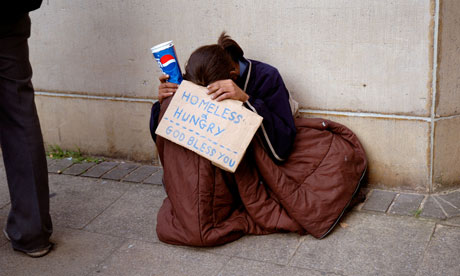
Young person homeless hungry and begging in London.

A young homeless person begging in London.
Photograph: Janine Wiedel Photolibrary


I'm in Jordan for a conference and I asked a friend who works for the ministry of planning and international co-operation what she remembered about her time in England (studying for a master's). She said: "Homeless people. There are no homeless people in Jordan." Walking around Jerash (just north of Amman, site of the largest Roman ruins outside Italy), I saw that what she said is true.

It is by no means the first time someone has told me of their surprise at seeing so many homeless people in England.

People from poor countries tend to assume that rich countries will have solved such social problems. But the reverse is true. According to a 2007 survey by York University's centre for housing policy, homelessness was found to be increasing in Sweden, Canada, the US, Poland, Hungary and the Czech Republic. The rate remains stable in Australia, and England and Germany were the only countries studied where falls in homelessness were apparent.

According to the survey, "economic transition [from socialism] has brought a degree of social disruption, and homelessness has emerged as an issue to be tackled" in Poland, the Czech Republic and Hungary.

A 2008 assessment of homeless in the US found there to be about 400,000 homeless people in the country, 30% of whom are defined as "chronic homeless".
~~~~~~~~~~~~~~~~~~~~~~~~~~~~~~~~~~~~~~
"I have now visited two countries where
there are no homeless people, Jordan and Cuba
– perhaps you will know of other examples.
Both are countries with serious problems, economic
and social. But they have managed to avoid this
particular assault on our collective dignity."
~~~~~~~~~~~~~~~~~~~~~~~~~~~~~~~~~~~~~~~~~~~~~~~~~
There are few forms of poverty worse that homelessness. Any hardship or challenge is best borne together with others, in family or community. In fact, hardship can bring communities together, bringichallenge is best borne together with others, in family or community. In fact, hardship can bring communities together, bringing out the best in the human spirit. It is a mistake to view poor people with pity, when they are often happier than affluent people. But there is no dignity in homelessness, in loneliness, in desperation and begging.

I have worked with street children in Medellín, Guatemala City and Kolkata. What they lacked most was not opportunity, safety and food, but family, friends and community. Allowing children to live on the street is the ultimate sign of societal failure, both moral and managerial. And yet homeless children are not just a poor-world phenomenon. According to a 2007 report by the European Federation of National Organisations Working with the Homeless, child homelessness is "slowly emerging as a problem in Europe, but will most likely increase if measures are not rapidly taken to counter this phenomenon".

I have now visited two countries where there are no homeless people, Jordan and Cuba – perhaps you will know of other examples. Both are countries with serious problems, economic and social. But they have managed to avoid this particular assault on our collective dignity. It would be worth reflecting on why, and what other countries can learn.

The reasons for homelessness are complicated – both structural and individual. My initial assumption, would be that in Jordan (and possibly elsewhere in the Middle East) a strong family culture will not allow homelessness. Cultural lessons are some of the hardest for other countries to learn, but this implies that countries adopting policies to encourage employment and economic growth should be careful not to also encourage family and community breakdown.

In Cuba, culture cannot be the reason for zero homelessness. In all other Latin countries, with similar cultures, homelessness is a grievous problem. I assume that Cuba's economic model keeps indigence to a minimum, and that a strong state response efficiently mops up any stragglers.

When I have written before about poor countries that have something to teach the rest of the world, including wealthier countries, some comments have been defensive. "I would prefer to live in England than in Jordan," comes the cry. But that is not the point. This is not a competition, nor does highlighting success in one area of social development mean disregarding major problems in another.

Homelessness is one of the most tragic forms of poverty, and it blights rich countries as much as poor ones. It is one of a growing number of social and economic problems that belie the separation of the world into developed and developing. We are all developing, and we all have lessons to learn from other cultures and countries.

Saturday, January 8, 2011

Gabrielle Giffords pray for Gabrielle's recovery
Gabrielle Giffords

Saturday, January 1, 2011

Democracy Now! by Amy Goodman


Trauma:
How We've Created a Nation Addicted to Shopping, Work, Drugs and Sex

"Post-industrial capitalism has completely destroyed the conditions required for healthy childhood development."

December 26, 2010

AMY GOODMAN: From disease to addiction, parenting to attention deficit disorder, Canadian physician and bestselling author Gabor Maté’s work focuses on the centrality of early childhood experiences to the development of the brain, and how those experiences can impact everything from behavioral patterns to physical and mental illness. While the relationship between emotional stress and disease, and mental and physical health more broadly, is often considered controversial within medical orthodoxy, Dr. Maté argues too many doctors seem to have forgotten what was once a commonplace assumption, that emotions are deeply implicated in both the development of illness, addictions and disorders, and in their healing.

Dr. Maté is the bestselling author of four books: When the Body Says No: Understanding the Stress-Disease Connection; Scattered: How Attention Deficit Disorder Originates and What You Can Do about It; and, with Dr. Gordon Neufeld, Hold on to Your Kids: Why Parents Need to Matter More than Peers; his latest is called In the Realm of Hungry Ghosts: Close Encounters with Addiction.

In our first conversation, Dr. Maté talked about his work as the staff physician at the Portland Hotel in Vancouver, Canada, a residence and harm reduction facility in Downtown Eastside, a neighborhood with one the densest concentrations of drug addicts in North America. The Portland hosts the only legal injection site in North America, a center that’s come under fire from Canada’s Conservative government. I asked Dr. Maté to talk about his patients.

DR. GABOR MATÉ: The hardcore drug addicts that I treat, are, without exception, people who have had extraordinarily difficult lives. And the commonality is childhood abuse. In other words, these people all enter life under extremely adverse circumstances. Not only did they not get what they need for healthy development, they actually got negative circumstances of neglect. I don’t have a single female patient in the Downtown Eastside who wasn’t sexually abused, for example, as were many of the men, or abused, neglected and abandoned serially, over and over again.

And that’s what sets up the brain biology of addiction. In other words, the addiction is related both psychologically, in terms of emotional pain relief, and neurobiological development to early adversity.

AMY GOODMAN: What does the title of your book mean, In the Realm of Hungry Ghosts?

DR. GABOR MATÉ: Well, it’s a Buddhist phrase. In the Buddhists’ psychology, there are a number of realms that human beings cycle through, all of us. One is the human realm, which is our ordinary selves. The hell realm is that of unbearable rage, fear, you know, these emotions that are difficult to handle. The animal realm is our instincts and our id and our passions.

Now, the hungry ghost realm, the creatures in it are depicted as people with large empty bellies, small mouths and scrawny thin necks. They can never get enough satisfaction. They can never fill their bellies. They’re always hungry, always empty, always seeking it from the outside. That speaks to a part of us that I have and everybody in our society has, where we want satisfaction from the outside, where we’re empty, where we want to be soothed by something in the short term, but we can never feel that or fulfill that insatiety from the outside. The addicts are in that realm all the time. Most of us are in that realm some of the time. And my point really is, is that there’s no clear distinction between the identified addict and the rest of us. There’s just a continuum in which we all may be found. They’re on it, because they’ve suffered a lot more than most of us.

AMY GOODMAN: Can you talk about the biology of addiction?

DR. GABOR MATÉ: For sure. You see, if you look at the brain circuits involved in addiction—and that’s true whether it’s a shopping addiction like mine or an addiction to opiates like the heroin addict—we’re looking for endorphins in our brains. Endorphins are the brain’s feel good, reward, pleasure and pain relief chemicals. They also happen to be the love chemicals that connect us to the universe and to one another.

Now, that circuitry in addicts doesn’t function very well, as the circuitry of incentive and motivation, which involves the chemical dopamine, also doesn’t function very well. Stimulant drugs like cocaine and crystal meth, nicotine and caffeine, all elevate dopamine levels in the brain, as does sexual acting out, as does extreme sports, as does workaholism and so on.

Now, the issue is, why do these circuits not work so well in some people, because the drugs in themselves are not surprisingly addictive. And what I mean by that is, is that most people who try most drugs never become addicted to them. And so, there has to be susceptibility there. And the susceptible people are the ones with these impaired brain circuits, and the impairment is caused by early adversity, rather than by genetics.

AMY GOODMAN: What do you mean, “early adversity”?

DR. GABOR MATÉ: Well, the human brain, unlike any other mammal, for the most part develops under the influence of the environment. And that’s because, from the evolutionary point of view, we developed these large heads, large fore-brains, and to walk on two legs we have a narrow pelvis. That means—large head, narrow pelvis—we have to be born prematurely. Otherwise, we would never get born. The head already is the biggest part of the body. Now, the horse can run on the first day of life. Human beings aren’t that developed for two years. That means much of our brain development, that in other animals occurs safely in the uterus, for us has to occur out there in the environment. And which circuits develop and which don’t depend very much on environmental input.

When people are mistreated, stressed or abused, their brains don’t develop the way they ought to. It’s that simple. And unfortunately, my profession, the medical profession, puts all the emphasis on genetics rather than on the environment, which, of course, is a simple explanation. It also takes everybody off the hook.

AMY GOODMAN: What do you mean, it takes people off the hook?

DR. GABOR MATÉ: Well, if people’s behaviors and dysfunctions are regulated, controlled and determined by genes, we don’t have to look at child welfare policies, we don’t have to look at the kind of support that we give to pregnant women, we don’t have to look at the kind of non-support that we give to families, so that, you know, most children in North America now have to be away from their parents from an early age on because of economic considerations. And especially in the States, because of the welfare laws, women are forced to go find low-paying jobs far away from home, often single women, and not see their kids for most of the day. Under those conditions, kids’ brains don’t develop the way they need to.

And so, if it’s all caused by genetics, we don’t have to look at those social policies; we don’t have to look at our politics that disadvantage certain minority groups, so cause them more stress, cause them more pain, in other words, more predisposition for addictions; we don’t have to look at economic inequalities. If it’s all genes, it’s all—we’re all innocent, and society doesn’t have to take a hard look at its own attitudes and policies.

AMY GOODMAN: Can you talk about this whole approach of criminalization versus harm reduction, how you think addicts should be treated, and how they are, in the United States and Canada?

DR. GABOR MATÉ: Well, the first point to get there is that if people who become severe addicts, as shown by all the studies, were for the most part abused children, then we realize that the war on drugs is actually waged against people that were abused from the moment they were born, or from an early age on. In other words, we’re punishing people for having been abused. That’s the first point.

The second point is, is that the research clearly shows that the biggest driver of addictive relapse and addictive behavior is actually stress. In North America right now, because of the economic crisis, a lot of people are eating junk food, because junk foods release endorphins and dopamine in the brain. So that stress drives addiction.

Now imagine a situation where we’re trying to figure out how to help addicts. Would we come up with a system that stresses them to the max? Who would design a system that ostracizes, marginalizes, impoverishes and ensures the disease of the addict, and hope, through that system, to rehabilitate large numbers? It can’t be done. In other words, the so-called “war on drugs,” which, as the new drug czar points out, is a war on people, actually entrenches addiction deeply. Furthermore, it institutionalizes people in facilities where the care is very—there’s no care. We call it a “correctional” system, but it doesn’t correct anything. It’s a punitive system. So people suffer more, and then they come out, and of course they’re more entrenched in their addiction than they were when they went in.

AMY GOODMAN: I’m curious about your own history, Gabor Maté.

DR. GABOR MATÉ: Yeah.

AMY GOODMAN: You were born in Nazi-occupied Hungary?

DR. GABOR MATÉ: Well, ADD has a lot to do with that. I have attention deficit disorder myself. And again, most people see it as a genetic problem. I don’t. It actually has to do with those factors of brain development, which in my case occurred as a Jewish infant under Nazi occupation in the ghetto of Budapest. And the day after the pediatrician—sorry, the day after the Nazis marched into Budapest in March of 1944, my mother called the pediatrician and says, “Would you please come and see my son, because he’s crying all the time?” And the pediatrician says, “Of course I’ll come. But I should tell you, all my Jewish babies are crying.”

Now infants don’t know anything about Nazis and genocide or war or Hitler. They’re picking up on the stresses of their parents. And, of course, my mother was an intensely stressed person, her husband being away in forced labor, her parents shortly thereafter being departed and killed in Auschwitz. Under those conditions, I don’t have the kind of conditions that I need for the proper development of my brain circuits. And particularly, how does an infant deal with that much stress? By tuning it out. That’s the only way the brain can deal with it. And when you do that, that becomes programmed into the brain.

And so, if you look at the preponderance of ADD in North America now and the three millions of kids in the States that are on stimulant medication and the half-a-million who are on anti-psychotics, what they’re really exhibiting is the effects of extreme stress, increasing stress in our society, on the parenting environment. Not bad parenting. Extremely stressed parenting, because of social and economic conditions. And that’s why we’re seeing such a preponderance.

So, in my case, that also set up this sense of never being soothed, of never having enough, because I was a starving infant. And that means, all my life, I have this propensity to soothe myself. How do I do that? Well, one way is to work a lot and to gets lots of admiration and lots of respect and people wanting me. If you get the impression early in life that the world doesn’t want you, then you’re going to make yourself wanted and indispensable. And people do that through work. I did it through being a medical doctor. I also have this propensity to soothe myself through shopping, especially when I’m stressed, and I happen to shop for classical compact music. But it goes back to this insatiable need of the infant who is not soothed, and they have to develop, or their brain develop, these self-soothing strategies.

AMY GOODMAN: How do you think kids with ADD, with attention deficit disorder, should be treated?

DR. GABOR MATÉ: Well, if we recognize that it’s not a disease and it’s not genetic, but it’s a problem of brain development, and knowing the good news, fortunately—and this is also true for addicts—that the brain, the human brain, can develop new circuits even later on in life—and that’s called neuroplasticity, the capacity of the brain to be molded by new experience later in life—then the question becomes not of how to regulate and control symptoms, but how do you promote development. And that has to do with providing kids with the kind of environment and nurturing that they need so that those circuits can develop later on.

That’s also, by the way, what the addict needs. So instead of a punitive approach, we need to have a much more compassionate, caring approach that would allow these people to develop, because the development is stuck at a very early age.

AMY GOODMAN: You began your talk last night at Columbia, which I went to hear, at the law school, with a quote, and I’d like you to end our conversation with that quote.

DR. GABOR MATÉ: Would that be the quote that only in the presence of compassion will people allow themselves—

AMY GOODMAN: Mahfouz.

DR. GABOR MATÉ: Oh, oh, no, yeah, Naguib Mahfouz, the great Egyptian writer. He said that "Nothing records the effects of a sad life” so completely as the human body—“so graphically as the human body.” And you see that sad life in the faces and bodies of my patients.

AMY GOODMAN: Dr. Gabor Maté, author of In the Realm of Hungry Ghosts: Close Encounters with Addiction. He’s a bestselling author. He’s a physician in Canada.

In that first interview, we touched briefly on his work on attention deficit disorder, the subject of his book Scattered: How Attention Deficit Disorder Originates and What You Can Do about It. Well, just about a month ago, we had Dr. Maté back on Democracy Now! to talk more about ADD, as well as parenting, bullying, the education system, and how a litany of stresses on the family environment is leading to what he calls the "destruction of the American childhood."

DR. GABOR MATÉ: In the United States right now, there are three million children receiving stimulant medications for ADHD.

AMY GOODMAN: ADHD means?

DR. GABOR MATÉ: Attention deficit hyperactivity disorder. And there are about half-a-million kids in this country receiving heavy-duty anti-psychotic medications, medications such as are usually given to adult schizophrenics to regulate their hallucinations. But in this case, children are getting it to control their behavior. So what we have is a massive social experiment of the chemical control of children’s behavior, with no idea of the long-term consequences of these heavy-duty anti-psychotics on kids.

And I know that Canadians statistics just last week showed that within last five years, 43—there’s been a 43 percent increase in the rate of dispensing of stimulant prescriptions for ADD or ADHD, and most of these are going to boys. In other words, what we’re seeing is an unprecedented burgeoning of the diagnosis. And I should say, really, I’m talking about, more broadly speaking, what I would call the destruction of American childhood, because ADD is just a template, or it’s just an example of what’s going on. In fact, according to a recent study published in the States, nearly half of American adolescents now meet some criteria or criteria for mental health disorders. So we’re talking about a massive impact on our children of something in our culture that’s just not being recognized.

AMY GOODMAN: Explain exactly what attention deficit disorder is, what attention deficit hyperactivity disorder is.

DR. GABOR MATÉ: Well, specifically ADD is a compound of three categorical set of symptoms. One has to do with poor impulse control. So, these children have difficulty controlling their impulses. When their brain tells them to do something, from the lower brain centers, there’s nothing up here in the cortex, which is where the executive functions are, which is where the functions are that are supposed to tell us what to do and what not to do, those circuits just don’t work. So there’s poor impulse control. They act out. They behave aggressively. They speak out of turn. They say the wrong thing. Adults with ADD will shop compulsively, or impulsively, I should say, and, again, behave in impulsive fashion. So, poor impulse control.

But again, please notice that the impulse control problem is general amongst kids these days. In other words, it’s not just the kids diagnosed with ADD, but a lot of kids. And there’s a whole lot of new diagnoses now. And children are being diagnosed with all kinds of things. ADD is just one example. There’s a new diagnosis called oppositional defiant disorder, which again has to do with behaviors and poor impulse control, so that impulse control now has become a problem amongst children, in general, not just the specific ones diagnosed with ADD.

The second criteria for ADD is physical hyperactivity. So the part of the brain, again, that’s supposed to regulate physical activity and keep you still just, again, doesn’t work.

And then, finally, in the third criteria is poor attention skills—tuning out; not paying attention; mind being somewhere else; absent-mindedness; not being able to focus; beginning to work on something, five minutes later the mind goes somewhere else. So, kind of a mental restlessness and the lack of being still, lack of being focused, lack of being present. These are the three major criteria of ADD.

AMY GOODMAN: I want to go to this point that you just raised about the destruction of American childhood. What do you mean by that?

DR. GABOR MATÉ: Well, the conditions in which children develop have been so corrupted and troubled over the last several decades that the template for normal brain development is no longer present for many, many kids. And Dr. Bessel Van der Kolk, who’s a professor of psychiatry at Boston—University of Boston, he actually says that the neglect or abuse of children is the number one public health concern in the United States. A recent study coming out of Notre Dame by a psychologist there has shown that the conditions for child development that hunter-gatherer societies provided for their children, which are the optimal conditions for development, are no longer present for our kids. And she says, actually, that the way we raise our children today in this country is increasingly depriving them of the practices that lead to well-being in a moral sense.

So what’s really going on here now is that the developmental conditions for healthy childhood psychological and brain development are less and less available, so that the issue of ADD is only a small part of the general issue that children are no longer having the support for the way they need to develop.

As I made the point in my book about addiction, as well, the human brain does not develop on its own, does not develop according to a genetic program, depends very much on the environment. And the essential condition for the physiological development of these brain circuits that regulate human behavior, that give us empathy, that give us a social sense, that give us a connection with other people, that give us a connection with ourselves, that allows us to mature—the essential condition for those circuits, for their physiological development, is the presence of emotionally available, consistently available, non-stressed, attuned parenting caregivers.

Now, what do you have in a country where the average maternity leave is six weeks? These kids don’t have emotional caregivers available to them. What do you have in a country where poor women, nearly 50 percent of them, suffer from postpartum depression? And when a woman has postpartum depression, she can’t be attuned to the child.

AMY GOODMAN: And what about fathers?

DR. GABOR MATÉ: Well, the situation with fathers is, is that increasingly—there was a study recently that showed an increasing number of men are having postpartum depression, as well. And the main role of the father, of course, would be to support the mother. But when people are—emotionally, because the cause of postpartum depression in the mother it is not intrinsic to the mother—not intrinsic to the mother.

What we have to understand here is that human beings are not discrete, individual entities, contrary to the free enterprise myth that people are competitive, individualistic, private entities. What people actually are are social creatures, very much dependent on one another and very much programmed to cooperate with one another when the circumstances are right. When that’s not available, if the support is not available for women, that’s when they get depressed. When the fathers are stressed, they’re not supporting the women in that really important, crucial bonding role in the beginning. In fact, they get stressed and depressed themselves.

The child’s brain development depends on the presence of non-stressed, emotionally available parents. In this country, that’s less and less available. Hence, you’ve got burgeoning rates of autism in this country. It’s going up like 20- or 30-fold in the last 30 or 40 years.

AMY GOODMAN: Say what you mean by autism.

DR. GABOR MATÉ: Well, autism is a whole spectrum of disorders, but the essential quality of it is an emotional disconnect. These children are living in a mind of their own. They don’t respond appropriately to emotional cues. They withdraw. They act out in an aggressive and sometimes just unpredictable fashion. They don’t know how to—there’s no sense—there’s no clear sense of a emotional connection and just peace inside them.

And there’s many, many more kids in this country now, several-fold increase, 20-fold increase in the last 30 years. The rates of anxiety amongst children is increasing. The numbers of kids on antidepressant medications has increased tremendously. The number of kids being diagnosed with bipolar disorder has gone up. And then not to mention all the behavioral issues, the bullying that I’ve already mentioned, the precocious sexuality, the teenage pregnancies. There’s now a program, a so-called "reality show," that just focuses on teenage mothers.

You know, in other words—see, it never used to be that children grew up in a stressed nuclear family. That wasn’t the normal basis for child development. The normal basis for child development has always been the clan, the tribe, the community, the neighborhood, the extended family. Essentially, post-industrial capitalism has completely destroyed those conditions. People no longer live in communities which are still connected to one another. People don’t work where they live. They don’t shop where they live. The kids don’t go to school, necessarily, where they live. The parents are away most of the day. For the first time in history, children are not spending most of their time around the nurturing adults in their lives. And they’re spending their lives away from the nurturing adults, which is what they need for healthy brain development.

[...]

AMY GOODMAN: Talk about how the drugs, Gabor Maté, affect the development of the brain.

DR. GABOR MATÉ: In ADD, there’s an essential brain chemical, which is necessary for incentive and motivation, that seems to be lacking. That’s called dopamine. And dopamine is simply an essential life chemical. Without it, there’s no life. Mice in a laboratory who have no dopamine will starve themselves to death, because they have no incentive to eat. Even though they’re hungry, and even though their life is in danger, they will not eat, because there’s no motivation or incentive. So, partly, one way to look at ADD is a massive problem of motivation, because the dopamine is lacking in the brain. Now, the stimulant medications elevate dopamine levels, and these kids are now more motivated. They can focus and pay attention.

However, the assumption underneath giving these kids medications is that what we’re dealing with here is a genetic disorder, and the only way to deal with it is pharmacologically. And if you actually look at how the dopamine levels in a brain develop, if you look at infant monkeys and you measure their dopamine levels, and they’re normal when they’re with their mothers, and when you separate them from mothers, the dopamine levels go down within two or three days.

So, in other words, what we’re doing is we’re correcting a massive social problem that has to do with disconnection in a society and the loss of nurturing, non-stressed parenting, and we’re replacing that chemically. Now, the drugs—the stimulant drugs do seem to work, and a lot of kids are helped by it. The problem is not so much whether they should be used or not; the problem is that 80 percent of the time a kid is prescribed a medication, that’s all that happens. Nobody talks to the family about the family environment. The school makes no attempt to change the school environment. Nobody connects with these kids emotionally. In other words, it’s seen simply as a medical or a behavioral problem, but not as a problem of development.

AMY GOODMAN: Gabor Maté, you talk about acting out. What does acting out mean?

DR. GABOR MATÉ: Well, it’s a great question. You see, when we hear the phrase "acting out," we usually mean that a kid is behaving badly, that a child is being obstreperous, oppositional, violent, bullying, rude. That’s because we don’t know how to speak English anymore. The phrase "acting out" means you’re portraying behavior that which you haven’t got the words to say in language. In a game of charades, you have to act out, because you’re not allowed to speak. If you landed in a country where nobody spoke your language and you were hungry, you would have to literally demonstrate your anger—sorry, your hunger, through behavior, pointing to your mouth or to your empty belly, because you don’t have the words.

My point is that, yes, a lot of children are acting out, but it’s not bad behavior. It’s a representation of emotional losses and emotional lacks in their lives. And whether it’s, again, bullying or a whole set of other behaviors, what we’re dealing with here is childhood stunted emotional development—in some cases, stunted pain development. And rather than trying to control these behaviors through punishments, or even just exclusively through medications, we need to help these kids develop.

AMY GOODMAN: You mentioned you suffered from ADD, attention deficit disorder, yourself—

DR. GABOR MATÉ: Yeah.

AMY GOODMAN:—and were drugged for it. Explain your own story.

DR. GABOR MATÉ: Well, I was in my early fifties, and I was working in palliative care at the time. I was coordinator of a palliative care unit at a large Canadian hospital. And a social worker in the unit, who had just been diagnosed as an adult, told me about her story. And as a physician, I was like most physicians who know nothing about ADD. Most physicians really don’t know about the condition. But when she told me her story, I realized that was me. And subsequently, I was diagnosed. And—

AMY GOODMAN: And what was that story? What did you realize was you?

DR. GABOR MATÉ: Oh, poor impulse control a lot of my life, impulsive behaviors, disorganization, a tendency to tune out a lot, be absentminded, and physical restlessness. I mean, I had trouble sitting still. All the traits, you know, that I saw in the literature on ADD, I recognized in myself, which was kind of an epiphany, in a sense, because you get to understand—at least you get a sense of why you’re behaving the way you’re behaving.

What never made sense to me right from the beginning, though, is the idea of ADD as a genetic disease. And not even after a couple of my kids were diagnosed with it, I still didn’t buy the idea that it’s genetic, because it isn’t. Again, it has to do with, in my case, very stressed circumstances as an infant, which I talked about on a previous program. In the case of my children, it’s because their father was a workaholic doctor who wasn’t emotionally available to them. And under those circumstances, children are stressed. I mean, if children are stressed when their brains are developing, one way to deal with the stress is to tune out.

AMY GOODMAN: Talk about holding on to your kids, why parents need to matter more than peers.

DR. GABOR MATÉ: Amy, in 1998, there was a book that was on the New York Times best book of the year and nearly won the Pulitzer Prize, and it was called The Nurture Assumption, in which this researcher argued that parents don’t make any difference anymore, because she looked at the—to the extent that Newsweek actually had a cover article that year entitled "Do Parents Matter?" Now, if you want to get the full stupidity of that question, you have to imagine a veterinarian magazine asking, "Does the mother cat make any difference?" or "Does the mother bear matter?" But the research showed that children are being more influenced now, in their tastes, in their attitudes, in their behaviors, by peers than by parents. This poor researcher concluded that this is somehow natural. And what she mistook was that what is the norm in North America, she actually thought that was natural and healthy. In fact, it isn’t.

So, our book, Hold on to Your Kids: Why Parents Need to Matter More than Peers, is about showing why it is true that children are being more influenced by other kids in these days than by their parents, but just what an aberration that is, and what a distortion it is of normal human development, because normal human development demands, as normal mammalian development demands, the presence of nurturing parents. You know, even birds—birds don’t develop properly unless the mother and father bird are there. Bears, cats, rats, mice. Although, most of all, human beings, because human beings are the least mature and the most dependent for the longest period of time.

AMY GOODMAN: Can you talk about the importance of attachment?

DR. GABOR MATÉ: Attachment is the drive to be close to somebody, and attachment is a power force in human relationship—in fact, the most powerful force there is. Even as adults, when attachment relationships that people want to be close to are lost to us or they’re threatened somehow, we get very disoriented, very upset. Now, for children and babies and adolescents, that’s an absolute necessity, because the more immature you are, the more you need your attachments. It’s like a force of gravity that pulls two bodies together. Now, when the attachment goes in the wrong direction, instead of to the adults, but to the peer group, childhood developments can be distorted, development is stopped in its tracks, and parenting and teaching become extremely difficult.

AMY GOODMAN: You co-wrote this book, and you both found, in your experience, Hold on to Your Kids, that your kids were becoming increasingly secretive and unreachable.

DR. GABOR MATÉ: Well, that’s the thing. You see, now, if your spouse or partner, adult spouse or partner, came home from work and didn’t give you the time of day and got on the phone and talked with other people all the time and spent all their time on email talking to other people, your friends wouldn’t say, "You’ve got a behavioral problem. You should try tough love." They’d say you’ve got a relationship problem. But when children act in these ways, we think we have a behavioral problem, we try and control the behaviors. In fact, what they’re showing us is that—my children showed this, as well—is that I had a relationship problem with them. They weren’t connected enough with me and too connected to the peer group. So that’s why they wanted to spend all their time with their peer group. And now we’ve given kids the technology to do that with. So the terrible downside of the internet is that now kids are spending time with each other—

AMY GOODMAN: Not even in the presence of each other.

DR. GABOR MATÉ: That’s exactly the point, because, you see, that’s an attachment dynamic. One of the basic ways that people attach to each other is to want to be with the people that you want to connect with. So when kids spend time with each other, it’s not a behavior problem; it’s a sign that their relationships have been skewed towards the peer group. And that’s why it’s so difficult to peel them off their computers, because their desperation is to connect with the people that they’re trying to attach to. And that’s no longer us, as the adults, as the parents in their life.

AMY GOODMAN: So how do you change this dynamic?

DR. GABOR MATÉ: Well, first we have to recognize its manifestations. And so, we have to recognize that whenever the child doesn’t look adults in the eye anymore, when the child wants to be always on the Skype or the cell phone or twittering or emailing or MSM messengering, you recognize it when the child becomes oppositional to adults. We tend to think that that’s a normal childhood phenomenon. It’s normal only to a certain degree.

AMY GOODMAN: Well, they have to rebel in order to separate later.

DR. GABOR MATÉ: No. They have to separate, but they don’t have to rebel. In other words, separation is a normal human—individuation is a normal human developmental stage. You have to become a separate, individual person. But it doesn’t mean you have to reject and be hostile to the values of the adults. As a matter of fact, in traditional societies, children would become adults by being initiated into the adult group by elders, like the Jewish Bar Mitzvah ceremony or the initiation rituals of tribal cultures around the world. Now kids are initiated by other kids. And now you have the gang phenomenon, so that the teenage gang phenomenon is actually a misplaced initiation and orientation ritual, where kids are now rebelling against adult values. But it’s not because they’re bad kids, but because they’ve become disconnected from adults.

AMY GOODMAN: Dr. Maté, there’s a whole debate about education in the United States right now. How does this fit in?

DR. GABOR MATÉ: Well, you have to ask, how do children learn? How do children learn? And learning is an attachment dynamic, as well. You learn when you want to be like somebody. So you copy them, so you learn from them. You learn when you’re curious. And you learn when you’re willing to try something, and if it doesn’t work, you try something else.

Now, here’s what happens. Caring about something and being curious about something and recognizing that something doesn’t work, you have to have a certain degree of emotional security. You have to be able to be open and vulnerable. Children who become peer-oriented—because the peer world is so dangerous and so fraught with bullying and ostracization and dissing and exclusion and negative talk, how does a child protect himself or herself from all that negativity in the peer world? Because children are not committed to each others’ unconditional loving acceptance. Even adults have a hard time giving that. Children can’t do it. Those children become very insecure, and emotionally, to protect themselves, they shut down. They become hardened, so they become cool. Nothing matters. Cool is the ethic. You see that in the rock videos. It’s all about cool. It’s all about aggression and cool and no real emotion. Now, when that happens, curiosity goes, because curiosity is vulnerable, because you care about something and you’re admitting that you don’t know. You won’t try anything, because if you fail, again, your vulnerability is exposed. So, you’re not willing to have trial and error.

And in terms of who you’re learning from, as long as kids were attaching to adults, they were looking to the adults to be modeling themselves on, to learn from, and to get their cues from. Now, kids are still learning from the people they’re attached to, but now it’s other kids. So you have whole generations of kids that are looking to other kids now to be their main cue-givers. So teachers have an almost impossible problem on their hands. And unfortunately, in North America again, education is seen as a question of academic pedagogy, hence these terrible standardized tests. And the very teachers who work with the most difficult kids are the ones who are most penalized.

AMY GOODMAN: Because if they don’t have good test scores, standardized test scores, in their class—

DR. GABOR MATÉ: They’re seen as bad teachers.

AMY GOODMAN:—then they could be fired. They’re seen as bad teachers, which means they’re going to want to kick out any difficult kids.

DR. GABOR MATÉ: That’s exactly it. The difficult kids are kicked out, and teachers will be afraid to go into neighborhoods where, because of troubled family relationships, the kids are having difficulties, the kids are peer-oriented, the kids are not looking to the teachers. And this is seen as a reflection. So, actually, teachers are being slandered right now. Teachers are being slandered now because of the failure of the American society to produce the right environment for childhood development.

AMY GOODMAN: Because of the destruction of American childhood.

DR. GABOR MATÉ: That’s right. What the problem reflects is the loss of the community and the neighborhood. We have to recreate that. So, the schools have to become not just places of pedagogy, but places of emotional connection. The teachers should be in the emotional connection game before they attempt to be in the pedagogy game.


Amy Goodman is the host of the nationally syndicated radio news program, Democracy Now!.

Thursday, December 30, 2010

New York Times' Travel Features Santa Cruz

photos Ann Johansson for The New York Times. A lone surfer on the beach. More Photos »
FORGET what you heard about Santa Cruz being the city that sleeps. Yes, this sunny coastal town still has its countercultural wackiness. You can still watch surfers shred waves, ride a seaside roller coaster on the Santa Cruz Beach Boardwalk and hear a street musician sing Pink Floyd’s “Goodbye Cruel World.” But Santa Cruz has been stirred by the tech boom in nearby Silicon Valley. In the past, “rabid localism” meant getting a black eye at the Stockton Avenue surf break. Now, the term refers to the restaurant that uses eggs from its own chicken coop, and the woman who churns organic ice cream with fennel foraged from a nearby field. And sleek

Friday

4 p.m.
1) PACIFIC CRUISE

Once the domain of seedy bars and bong displays, the southern section of Pacific Avenue is now a more fashionable strip where the city’s lust for vintage is on display. Idle Hands Dry Goods (803 Pacific Avenue; 831-466-9305; idlehandsdrygoods.com) feels like an updated Rolling Stones track, melding vintage American outlaw looks (cowboy boots, belt buckles) with rock-’n’-roller attitude (graphic T-shirts, Pendleton shirts). True Love Antiques & Vintage (805 Pacific Avenue; 714-847-3961), is a wonder cabinet of curios, art and odd-ends. And on nearby Cedar Street, MetaVinyl (320 Cedar Street; 831-466-9027; metavinyl.com) carries new and old LPs, turntable gear and rare finds, like a mint-condition copy of 2 Live Crew’s “As Nasty As They Wanna Be.”

7 p.m.
2) HAUT KEBABS

The staid dining scene in downtown Santa Cruz got a jolt this fall with the arrival of Laili (101B Cooper Street; 831-423-4545; lailirestaurant.com), a stylish Afghan restaurant. With its nattily dressed waiters, soaring ceilings and wall-size photo display of precious Afghan jewelry, this is no hole-in-the-wall kebab joint. A cross-section of Santa Cruz can be found on a given night, sampling Persian chive-stuffed Aushak dumplings ($9) and the braised lamb shank with kabuli rice and yogurt ($16). Ask for a seat at the communal table, where you can rub elbows with surfers and techies, and watch a cook in an open kitchen preparing naan dough with a giant rolling pin.

9 p.m.
3) LATIN RHYTHMS

The spiciest spot downtown is arguably the weekly salsa dance party at the historic Palomar Ballroom (1344 Pacific Avenue; 831-426-1221; palomarballroom.com), where dancers swirl in tight dresses, miniskirts and high heels. If you know your salsa moves, pay $5 at the door. If you need to brush up, a $10 fee covers a salsa class and the dance party.

Midnight
4) DEEP RED

A crimson glow beckons late-night patrons upstairs to the Red Restaurant & Bar (200 Locust Street; 831-425-1913; redsantacruz.com), a curiously dark lounge with hidden nooks that stays open until 2 a.m. Unless you sit by the fire, reading the menu can be a challenge, so try the Winnie ($7.75), a house-infused rose tea vodka with fresh lemon and simple syrup. Don’t confuse this spot with the Red Room, which occupies the floor below and is a rite of passage for college students.

Saturday

10 a.m.
5) WARM BRIOCHE

Stock up for an outdoor picnic along the scenic coastline. True to its name, the Buttery (702 Soquel Avenue; 831-458-3020; butterybakery.com) specializes in butter-rich comfort foods like lemon cheese pockets ($2.65) and blueberry muffins ($2.65). It also sells French baguettes ($2). Round out your supplies across the street at Shopper’s Corner (622 Soquel Avenue; 831-423-1398; shopperscorner.com), a local institution with a neon clock, local wines, hard cheeses and tapenades.

11 a.m.
6) TAKE A HIKE

A slow ride on West Cliff Drive offers views of cypress trees, eroded cliffs and epic surf breaks. Park at the Wilder Ranch State Park (1401 Old Coast Road; 831-423-9703; parks.ca.gov), a 7,000-acre park with numerous hiking trails that tunnel through misted forests of alders, Douglas firs and coastal redwoods. The park is also home to bobcats, feral piglets and the occasional cougar.

3 p.m.
7) GREEN HEDONISTS

Once home to a frozen vegetable processing plant, the Swift Street Courtyard (402 Ingalls Street) has been transformed into a kind of epicurean food court. The bittersweet Black IPA ($4.50) is a specialty at Santa Cruz Mountain Brewing (Suite 27; 831-425-4900; santacruzmountainbrewing.com), an organic microbrewery with a tiny tap room. If you’re hungry, order a platter of fish tacos ($12.50) delivered to the bar from the shop next door, Kelly’s French Bakery (831-423-9059; kellysfrenchbakery.com). Or, if you want to sample biodynamic wines, head to the tasting room at Bonny Doon Vineyard (328 Ingalls Street; 831-425-4518; bonnydoonvineyard.com), where a metal spaceship hovers overhead. A $5 flight of wine tastings includes a white Spanish varietal called albariño and a dry muscat, both made from Monterey County grapes.

6:30 p.m.
8) SEABRIGHT SALUMI

At La Posta (538 Seabright Avenue; 831-457-2782; lapostarestaurant.com), the flavors might hail from Italy, but the ingredients are local. This handsome restaurant, which opened four years ago in a former general store, draws locavores to the hushed neighborhood of Seabright. Examples of its farm-to-table ethos include the ortiche brick-oven pizza ($14) with wild nettles foraged at Route 1 Farm in Santa Cruz, and an escarole salad ($8) topped with a boiled egg that comes from the chickens out back.

8 p.m.
9) MUSIC BOXES

With its large college population, Santa Cruz has long been a hub for indie music. One of the best spots to hear live music is the Rio Theatre (831-423-8209; 1205 Soquel Avenue; riotheatre.com), a former movie house from the 1940s that reopened 10 years ago as a concert hall and features acts like Neko Case and Cat Power. Another reliable option is the Crepe Place (1134 Soquel Avenue; 831-429-6994; thecrepeplace.com), a small venue housed in a century-old Victorian building, where acts such as Erin McKeown and the cult favorite Dan Bern perform under the original stamped-tin ceiling.

11 p.m.
10) ROCKIN’ RYE

With its old armoires, velvet curtains and private room, 515 Kitchen and Cocktails (515 Cedar Street; 831-425-5051) has an air of sophisticated decadence that attracts young professionals, graduate students and neighborhood bartenders. House drinks include the Dry Dreams ($7.75), made of Old Overholt rye whiskey, lemon, egg whites and maple syrup.

Sunday

10 a.m.
11) BEACH WALK

After ordering a butter-slathered hot cinnamon roll ($2) at Linda’s Seabreeze Cafe (542 Seabright Avenue; 831-427-9713; seabreezecafe.com), walk to nearby Seabright State Beach (East Cliff Drive at Seabright Avenue), a long stretch of tan-white sand, with a midget lighthouse, a foghorn and a cave. The Municipal Wharf (21 Municipal Wharf; 831-420-6025; santacruzwharf.com), a large pier built in 1914 that draws fishermen and pods of barking sea lions, is nearby. Don’t trust your eyes: that set of “islands” is a fog-bound stretch of coastline.

2 p.m.
12) DEEP FREEZE

Two scoops of celery raisin ice cream? You won’t find that in the freezer case of the local supermarket, but it is among the eccentric flavors that are dreamed up at the Penny Ice Creamery (913 Cedar Street; 831-204-2523; thepennyicecreamery.com). The artisanal ice cream shop, which opened in late August in a former hair salon, changes its menu daily, so you never know whether it will have familiar options like rum raisin and dark chocolate, or whether Kendra L. Baker, one of the owners, has come up something nutty, like black sesame ice cream or mandarin creamsicle.

IF YOU GO

The nearest major commercial airport to Santa Cruz is in San Jose, about 45 minutes away by car.

The Santa Cruz Dream Inn (175 West Cliff Drive; 831-426-4330; dreaminnsantacruz.com), which reopened in 2008, is the city’s lone beachfront hotel, with a 1960s retro theme and Jetsons-style furniture. All 165 rooms have ocean views and private balconies, with rates starting at $179.

Made of sun-baked bricks, the Adobe on Green Street (103 Green Street; 831-469-9866; adobeongreen.com) is a four-room bed-and- breakfast that opened in 1999. It has a dahlia garden, giant birds of Paradise in front and old-timber floors, with rates from $119 weekdays, $189 Friday and Saturday, including a continental breakfast.

The new Pacific Blue Inn (636 Pacific Avenue; 831-600-8880; pacificblueinn.com) is an unfussy bed-and-breakfast with a leafy patio and hot breakfasts made to order. The nine rooms start at $168.

Cranky and Free: American Speech

City of Santa Cruz' DECORUM vs
Robert Norse's Free Speech

May Finally Get a Real Trial


Robert Norse this year, across the board from street photographer and angel
Ronee Webster Curry, on Pacific Avenue in downtown Santa Cruz, California.
Ronee has a mission that includes bringing comfort and love to street people and
homeless folks in our town. Thank you, Ronee.

Which they did, in March 2002, in an incident viewable on YouTube. As a gesture of silent protest when the Council asked someone else to stop talking, Mr. Norse raised his left arm in a Nazi salute. He was thrown out of the meeting, arrested when he refused to leave and released without charges. Mr. Norse then sued the city and Council members for infringing on his First Amendment right to sound off. But, on the eve of the trial and on his own motion, the trial judge threw out the case because, he said, the people Mr. Norse sued had official immunity.

The United States Court of Appeals for the Ninth Circuit unanimously sided with Mr. Norse, Dec. 15. In a tart and persuasive opinion, Judge Sidney Thomas said that in ruling on his own motion — sua sponte — and without adequate notice, the trial judge had not given Mr. Norse a fair chance to be heard and had thus abused the legal process.

He also made plain that even a guy who’s a pest can count on the protections of the First Amendment. It’s all right to set reasonable time limits on public comments, Judge Thomas said. But if you have a right to be in a place, the right to free speech comes with you.

As the Ninth Circuit’s chief judge, Alex Kozinski, wrote in a concurring opinion about what he saw on the YouTube video, it “clearly shows that Norse’s sieg heil was momentary and casual, causing no disruption whatsoever.” Mr. Norse is not the only beneficiary of the appellate court ruling. All of us who value free speech, even when it is obnoxious, are stronger for it.


Linda's Hearth note: Earlier article in blog shares the so-called "objective" journalism version of this news. In short, per Linda's Hearth, the Ninth Circuit's Appeals Court sent Norse's claim against the City BACK for trial, as the prior judge just skipped over court rules in favor of giving City Councilmembers "immunity", but forgot to check out the facts of the case.


A version of this editorial appeared in print on December 30, 2010, on page A28 of the New York edition.

The Times & the Bay Area - now at 50% off when you

subscribe for the convenience of home delivery.

Wednesday, December 29, 2010

No Social Safety Net? Germany Thinks We're Nuts!

America in Decline: A Look at Our Empire
Through the Eyes of the European Media


December 26, 2010
By Democrats Ramshield, from AlterNet


As an American expat living in the European Union, I’ve started to see America from a different perspective.

The European Union has a larger economy and more people than America does. Though it spends less -- right around 9 percent of GNP on medical, whereas we in the U.S. spend close to between 15 to 16 percent of GNP on medical -- the EU pretty much insures 100 percent of its population.

The U.S. has 59 million people medically uninsured; 132 million without dental insurance; 60 million without paid sick leave; 40 million on food stamps. Everybody in the European Union has cradle-to-grave access to universal medical and a dental plan by law. The law also requires paid sick leave; paid annual leave; paid maternity leave. When you realize all of that, it becomes easy to understand why many Europeans think America has gone insane.

Der Spiegel has run an interesting feature called "A Superpower in Decline," which attempts to explain to a German audience such odd phenomena as the rise of the Tea Party, without the hedging or attempts at "balance" found in mainstream U.S. media. On the Tea Parties:

Full of Hatred: "The Tea Party, that group of white, older voters who claim that they want their country back, is angry. Fox News host Glenn Beck, a recovering alcoholic who likens Obama to Adolf Hitler, is angry. Beck doesn't quite know what he wants to be -- maybe a politician, maybe president, maybe a preacher -- and he doesn't know what he wants to do, either, or least he hasn't come up with any specific ideas or plans. But he is full of hatred."

The piece continues with the sobering assessment that America’s actual unemployment rate isn’t really 10 percent, but close to 20 percent when we factor in the number of people who have stopped looking for work.

Some social scientists think that making sure large-scale crime or fascism never takes root in Europe again requires a taxpayer investment in a strong social safety net. Can we learn from Europe? Isn't it better to invest in a social safety net than in a large criminal justice system? (In America over 2 million people are incarcerated.)

Jobless Benefits That Never Run Out

Unlike here, in Germany jobless benefits never run out. Not only that -- as part of their social safety net, all job seekers continue to be medically insured, as are their families.

In the German jobless benefit system, when "jobless benefit 1" runs out, "jobless benefit 2," also known as HartzIV, kicks in. That one never gets cut off. The jobless also have contributions made for their pensions. They receive other types of insurance coverage from the state. As you can imagine, the estimated 2 million unemployed Americans who almost had no benefits this Christmas seems a particular horror show to Europeans, made worse by the fact that the U.S. government does not provide any medical insurance to American unemployment recipients. Europeans routinely recoil at that in disbelief and disgust.

In another piece the Spiegel magazine steps away from statistics and tells the story of Pam Brown, who personifies what is coming to be known as the Nouveau American poor. Pam Brown was a former executive assistant on Wall Street, and her shocking decline has become part of the American story:

American society is breaking apart. Millions of people have lost their jobs and fallen into poverty. Among them, for the first time, are many middle-class families. Meet Pam Brown from New York, whose life changed overnight. The crisis caught her unprepared. "It was horrible," Pam Brown remembers. "Overnight I found myself on the wrong side of the fence. It never occurred to me that something like this could happen to me. I got very depressed." Brown sits in a cheap diner on West 14th Street in Manhattan, stirring her $1.35 coffee. That's all she orders -- it's too late for breakfast and too early for lunch. She also needs to save money. Until early 2009, Brown worked as an executive assistant on Wall Street, earning more than $80,000 a year, living in a six-bedroom house with her three sons. Today, she's long-term unemployed and has to make do with a tiny one-bedroom in the Bronx.

It's important to note that no country in the European Union uses food stamps in order to humiliate its disadvantaged citizens in the grocery checkout line. Even worse is the fact that even the humbling food stamp allotment may not provide enough food for America’s jobless families. So it is on a reoccurring basis that some of these families report eating out of garbage cans to the European media.

For Pam Brown, last winter was the worst. One day she ran out of food completely and had to go through trash cans. She fell into a deep depression ... For many, like Brown, the downfall is a Kafkaesque odyssey, a humiliation hard to comprehend. Help is not in sight: their government and their society have abandoned them.

Pam Brown and her children were disturbingly, indeed incomprehensibly, allowed to fall straight to the bottom. The richest country in the world becomes morally bankrupt when someone like Pam Brown and her children have to pick through trash to eat, abandoned with a callous disregard by the American government. People like Brown have found themselves dispossessed due to the robber baron actions of the Wall Street elite.

Hunger in the Land of the Big Mac

A shocking headline from a Swiss newspaper reads (Berner Zeitung) “Hunger in the Land of the Big Mac.” Though the article is in German, the pictures are worth 1,000 words and need no translation. Given the fact that the Swiss virtually eliminated hunger, how do we as Americans think they will view these pictures, to which the American population has apparently been desensitized.

This appears to be a picture of two mothers collecting food boxes from the charity Feed the Children.

Perhaps the only way for us to remember what we really look like in America is to see ourselves through the eyes of others. While it is true that we can all be proud Americans, surely we don't have to be proud of the broken American social safety net. Surely we can do better than that. Can a European-style social safety net rescue the American working and middle classes from GOP and Tea Party warfare?

Linda's Hearth note: Believe me, Pam Brown, it gets way worse! to reders: I'll have to add the 2 photos next time.