Monday, October 3, 2011

Homeless People Have Right to Sanitation and Survival

United Nations Human Rights Expert Condemns Cruel Treatment of Homeless People in United States

The UN Rapporteur’s report is the latest in a series of condemnations by international experts of the criminalization and mistreatment of homeless persons in the United States. A growing record of both domestic and international law states that homeless persons cannot be criminalized for basic life-sustaining acts. -Street Spirit Editor Note

by Whitney Gent

National Law Center on Homelessness and Poverty

On August 24, in an official report to the United Nations Human Rights Council, a top UN investigator said that the United States’ failure to provide homeless persons access to water and sanitary facilities “could … amount to cruel, inhumane, or degrading treatment.” The report was issued by UN Special Rapporteur on the Human Right to Water and Sanitation Catarina de Albuquerque.

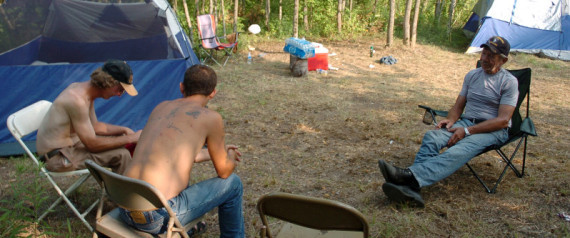
Tim engineered a sanitation system for the homeless community. Every week, he collects heavy bags of waste, and hauls them several miles to a public restroom.

Art by Christa Occhiogrosso


“The Rapporteur’s report is the latest in a series of condemnations by international experts of the criminalization and mistreatment of homeless persons in the U.S.,” said Eric Tars, human rights program director at the National Law Center on Homelessness & Poverty which helped facilitate her visit. “Earlier this year, the U.S. committed itself before the Human Rights Council to doing more to protect the rights of homeless persons. Where is the action to follow the words?”
Albuquerque visited the United States in February and March 2011, and was struck by the “extraordinary lengths” homeless persons had to go to just to remove bodily wastes. During a visit to the Safe Ground tent community near Sacramento, California, she met a man who called himself the community’s “sanitation technician.”

The man, “Tim,” engineered a sanitation system consisting of a seat overtop a two-layered plastic bag. Every week, Tim collects bags of human waste, weighing anywhere from 130 to 230 pounds, and hauls them on his bicycle several miles to a public restroom. When a toilet becomes available, he empties the contents of the bags. Following the disposal, he secures the dirty bags in a clean one, which he then places in the garbage, before washing his hands with water and lemon.
He said the job is difficult, but that he does it for the community — especially the women.
The UN Special Rapporteur’s report states: “The United States, one of the wealthiest countries in the world, must ensure that everyone [has access] to sanitation which is safe, hygienic, secure and which provides privacy and ensures dignity. An immediate, interim solution is to ensure access to restroom facilities in public places, including during the night. The long-term solution to homelessness must be to ensure adequate housing.”

In June 2010, the U.S. Interagency Council on Homelessness adopted its first-ever comprehensive plan to end homelessness, including a section promoting constructive alternatives to criminalization. However, the criminalization of homelessness by communities persists, and to date, the Justice Department and other agencies have done little to convey the unconstitutionality of these practices to local policymakers.

“This adds to a growing record of both domestic and international law stating that homeless persons cannot be criminalized for basic life-sustaining acts when the community provides no legal alternative,” said Maria Foscarinis, executive director of the Law Center. “But ultimately, we must remedy this situation because we, as Americans, believe that no person deserves to be treated this way.”


http://www.thestreetspirit.org/un-expert-condemns-cruel-treatment-of-homeless-in-u-s-2/

Whitney Gent wrote this article for The National Law Center on Homelessness & Poverty.
Read the Rapporteur’s Report here.


Wednesday, September 28, 2011

Federal Court for PeaceCamp2010's Chris Doyon

TPMMuckraker

Feds: Homeless Computer Hacker Launched 'Anonymous' Attack Over Anti-Camping Law


A homeless man upset over an anti-camping law in Santa Cruz took part in a distributed denial of service (DDoS) attack on the city's computer servers last December, the feds charged Thursday.

As we told you earlier today, the feds arrested two men for hacking attacks today: an Arizona 23-year-old who allegedly hacked into Sony's servers and a California man who Fox News reported is homeless.

The federal grand jury indictment out of San Jose is against 47-year-old Christopher Doyon along with Joshua John Covelli, who had been charged in the previous Anonymous round-up.

Federal authorities couldn't confirm that Doyon was homeless. "At this point, I can only confirm what is in the press release and the indictment and unfortunately the only information I have is that he is a resident of Mountain View," FBI spokeswoman Julie Sohn told TPM in an email.

But a quick Google search turns up a story mentioning Doyon as believing it was his "freedom and right" to sleep almost anywhere he wanted outdoors.

"We're not asking for money. We simply want them to lift the sleeping ban and let us sleep," he said, according to a local report. "It won't cost them a dime."

Doyon is charged with participating in a Distributed Denial of Service (DDoS) attack against Santa Cruz County's computer servers on Dec. 16. The People's Liberation Front (PLF) allegedly coordinated and executed the attack, according to the feds. The feds explain in a press release:

The City of Santa Cruz enacted Section 6.36.010 of its Municipal Code, entitled "Camping Prohibited," which contained restrictions and definitions on camping within Santa Cruz City. In response to the enforcement of Section 6.36.010, protesters occupied the Santa Cruz County Courthouse premises from approximately July 4, 2011 to Oct. 2, 2011. Law enforcement officers from Santa Cruz County disbanded the protest and several protesters were charged with misdemeanors crimes in Santa Cruz County.

In retribution for Santa Cruz City's enforcement of Section 6.36.010 of the Municipal Code, and Santa Cruz County's disbandment of the protest, the PLF co-ordinated and executed a DDoS attack against Santa Cruz County's computer servers. The PLF referred to these co-ordinated attacks as "Operation Peace Camp 2010." According to the indictment, as part of Operation Peace Camp 2010, Doyon, Covelli and others allegedly conspired to intentionally damage the protected computers hosting the website for the County of Santa Cruz.

Doyon, the feds said, appeared before a federal judge in San Jose today, where he was remanded and had a court date set for Sept. 29.

Sunday, September 18, 2011

Lodging Trials: Judge Accepts Considering "Writ of Habeus Corpus"

Lemaster PC 647 (e) Case
Postponed until October 28th

by Becky Johnson

Santa Cruz, Ca. -- Appearing in court on Wednesday, September14th for a
pre-trial readiness hearing, Linda Lemaster still faces misdemeanor "illegal
lodging" for allegedly falling asleep at PeaceCamp2010 on a single night in
August 2010.

Her pro bono attorney, Jonathon Gettleman, filed a comprehensive writ of habeas
corpus, claiming that 647(e) is vague and overbroad, and that Lemaster's freedom
of speech was truncated when County Sheriff Deputies used the antique "lodging"
law to break up an otherwise legal protest.

Deputy District Attorney Sara Dabkowski again offered to reduce Lemaster's
charges to an infraction with zero public service as a consequence. Having
previewed the Writ a week earlier, Lemaster declined again.

In court, Judge John Gallagher, Dept 2, ordered DA Dabkowski to answer
Gettleman's "well-written, voluminous" brief by October 14th, with Gettleman's
response to hers due by October 21st. A hearing on the 'writ' is set for October
28th. If a trial is to result, the date will be set then. The hearing is to take
a closer look at the Lodging law as applied during PeaceCamp2010.

In related news, Ed Frey and Gary Johnson, convicted of PC 647(e) in May 2011,
have received the court-approved complete transcript of their trial in order to
file their appeals. Frey and Johnson still face the remainder of their 6 month
sentences should their appeals fail.

# # # #


Linda's Hearth note: I was very impressed by the "Writ of habeas Corpus", eighty pages my attorney brought together to bring the First Amendment back into these trials and hearings. As a long time advocate for homeless families and individuals, I felt a kind of validation when I saw the Jones and Eichorn cases, and the ghost of Mitch Snyner in gettleman's citing the Community for Creative Nonviolence's supreme court's decision, in this Writ.

I hope to be able to focus for a bit now, health permitting, on a fundraising
dinner. To raise money for legal costs, but this event also hopes to function as
a thank-you for both attorneys involved so far with this lodging law stuff.

I'm forming a "dinner committee" (and it 'may' not be a consensual one?). If any of
you would like to be contacted or included in planning and carrying out such an
event, e me back with your phone number or preferred contact info (I have
neither a meeting directory nor a computer in my home at present).


If you have not read "my" article in Street Spirit's September issue, here's the
URL to their dynamic website: thestreetspirit.org. Putting "my" in quote marks
because it was largely and sensitively edited (two stories into one!) by Street
Spirit's editor Terry Messman, who deserves equal credit on the writing in this
instance.


warmly, Linda Ellen Lemaster
Housing NOW! in Santa Cruz
P O Box 42, Davenport, CA 95017

Thursday, September 15, 2011

THE LODGING LAW Trial Readiness Hearing Sept 14th

Yesterday in court, Judge John Gallagher accepted the Writ of Habeus Corpus filed weeks ago by my pro bono attorney, Jonathan Che Gettleman. He ordered the District Attorney to answer it by Oct 14th. Gettleman's reply will then be due seven days forward: Oct 21.

Then, a hearing about the Writ on October 28th will be held in Dept 2. The writ of habeus corpus attempts to bring together the actual setting and situation, with the incident of my getting a Lodging citation.

I am very much hoping that a closer peek at the Lodging law and it's history, which is as controversial as the law is vague here, will bring greater safety and relief to people all over California, especially homeless people with ever-diminishing safety options for sleeping. Maybe just a baby step, and maybe, God willing, we will effectively expose the misuse of this law?

In the best case scenario on October 28th, it could make furthering the trial unnecessary. Look for article I wrote about PeaceCamp2010 and about these unfolding trials and "trials", at thestreetspirit.org. Or get in touch with me for a paper copy, or -- if you are homeless -- to help vend them, and you get to keep the $1.00 per copy.

Saturday, September 10, 2011

PeaceCamp2010 and the 2011 Lodging Trials ~ reprinted from Street Spirit, Sept 2011

Arrested for ‘Sleepcrimes’ at
Peace Camp in Santa Cruz


Laying down for the right to sleep is dangerous in Santa Cruz. The jurors found all but one of these “sleep criminals” guilty. Actually, it was a homeless man’s dog who was found not guilty. When the courts have criminalized sleeping by the poor, how can anyone sleep well tonight? - ed note, thestreet spirit.org

by Linda Ellen Lemaster

PeaceCamp2010 started on the Fourth of July weekend last year outside the Santa Cruz Courthouse, and lasted until a few days past Labor Day. When I first visited the camp in July 2010, I was moved to offer my support to the ever-changing group of protesters.

People I met in the first week were totally focused on bringing attention to the public about the insidious criminalization of sleeping, camping and lodging used to banish homeless people from any public areas and force them into hiding.

After sheriff deputies banished the demonstration from the lawn in front of the courthouse, the sleep-protesters returned to City Hall, intent on renewing the primary message of the demonstration: to show that the Santa Cruz ordinance that criminalizes sleeping and camping in public is too broad, too prohibitive and too dangerous.

I had recently testified in court as an “expert witness” about homelessness in Santa Cruz, so I had already met some new friends who also turned up at this Fourth of July demonstration, which ultimately kept on going like the energizer bunny.

In early July of 2010, nobody I met realized that PeaceCamp2010 would continue for several months, and then be abruptly terminated by Santa Cruz County sheriff deputies working in four-person teams. Joining the peace camp carried a price. On Sept. 19, 2011, I go to trial for getting a ticket claiming I broke the State of California’s lodging law, 647(e).

PeaceCamp2010 located itself right in front of the Santa Cruz County Superior Court, where citizens traditionally gather to share ideals and to bring concerns to their government.

Local attorney and philosopher Ed Frey was deemed a hero by many homeless people who found their way to the demonstration in support of the right to sleep even while homeless. Frey, with the help of long-standing homeless ally Paul Lee, had found the means to provide a porta-potty nightly at the peace camp, and mounted the rented utility on a small trailer behind his pickup truck.

Frey had been listening carefully to reveries of homeless folks and their allies, hoping to figure out all the “health and safety” issues in advance.

His conclusion was right-on: “potty” was the missing ingredient for sustaining many earlier pro-homeless and anti-sleeping-ban rallies, marches and demonstrations, including several held at this very location.

PeaceCamp2010 was like a living kaleidoscope. While a number of folks stayed with it — the regulars, you might say — a majority of faces at the camp changed every few days. It was run as though we were all adults — most refreshing. Sure, leaders emerged, receded, emerged again. Yet there was a “live and let live” air to this sleep demonstration that seemed to welcome all comers.

Once publicity about the camp began, an average night might find two dozen folks sleeping there, though at times PeaceCamp2010 exceeded 50 folks with blankets and sleeping bags unfurled on the lawn and concrete plaza.


Mass media fuels stereotypes

The demonstration received abundant, even front-page, press coverage. Most of it was negative, in my view: the press was feeding off stereotypes and playing to the resentments of the general housed population. The television news was gentler — vague yet visually honest.

PeaceCamp2010 denizens responded by cultivating Social Media to get their message out.

Later, tensions began to build around antagonisms and fears of County employees and citizens on business at the County offices, many of whom did not appreciate having to see the artifacts of homelessness while on their way to work.

It was apparent that holding a “sleep demonstration” as a legitimate message of protest went far over the heads of most passers-by. We were following a long tradition that reckons sleep in this context as a necessary form of free speech.

So many other venues for protest had not worked locally, and some even backfired — as evidenced by troll-busting murders and assaults in Santa Cruz, by the ever-growing numbers of anti-homeless laws and regulations, and by the broadening acceptance of those overt haters of visibly poor and presumed homeless folks.

I believe our inability to get our message shared in the media, without extreme distortion, in the past 25 years also helps fuel this growing “blame the victim” mentality.

Ultimately, the last few determined, demonstrating sleepers were flushed off the campus of City Hall by the police. Because of the protest, political officials and the city police continued to tighten the rules about being present at City Hall and the Santa Cruz Library. Police were ruthless at best regarding our signs and the personal property they confiscated.

Santa Cruz officials made it functionally impossible for demonstrators to get their belongings back once confiscated, and the police grabbed people’s possessions several times a night.

From Albany, Calif., to Orlando, Fla., most homeless people can’t turn their backs on their belongings for a minute, and police pose as many risks as thieves and desperados. I note the property destruction because over and over homeless people have been protected by the courts on this issue, only to have this “justice” conveniently forgotten when political protesters enter the picture.

Criminal acts of sleeping

Demonstrators had formed the peace camp specifically to protest the laws that criminalize anyone found asleep in public at night. Ironically, during the final days, they were cited and displaced by police using the very laws they were protesting: the State of California’s lodging law, and the City’s sleeping ban ordinance.

Santa Cruz officials continued attacking the remaining few demonstrators for camping on the sidewalk at night. They used many new tricks, including klieg lights and a huge blaring generator that spewed toxic exhaust all night, until finally neighbors a block away complained. They confiscated our protest signs as fast as we could create new ones.

The hostile attitude toward any public presence of homeless people is not new here. It continues despite what now even the courts have ruled is true: a person cannot live without sleeping. Enforcing the sleeping ban while no other alternatives exist is destructive and life-threatening. The County’s purpose in citing demonstrators for sleeping and lodging was to stifle our political expression.

Gary and Star were the troopers throughout the final stages of PeaceCamp2010, stoically enduring until after Labor Day. They and others were arrested and given many citations for trying to continue PeaceCamp2010. Laying down for the right to sleep is dangerous in California.
Ten months later, tickets started cropping up on court dockets like mushrooms after a spring rain. Some charges were swept away, some traded out informally for “lesser” charges. Some who were cited during the sleep-out have disappeared.

By April 2011, local judges had casually determined that California’s anti-lodging law, 647(e), would not be deemed unconstitutional despite the law’s controversial history and its current misuse. Five homeless defendants engaged Ed Frey as their attorney. He also represented himself.

Three homeless men and one homeless woman, plus Frey, went on trial together; ultimately two defendants testified on their own behalf during the four-day trial. Watching Frey interview himself and then answer himself was a highlight of their trial in May 2011.


Humans guilty, dog acquitted

The jurors found all but one of these “sleep criminals” guilty. Actually, it was a homeless man’s dog who was found not guilty, but the jurors let the man go free on behalf of his dog. One juror was unable to accept the fate of a dog in the hands of police, then the pound, due to a criminal homeless sleeper.

The homeless defendant, Bob is his street name, would have had to pay several hundred dollars to avert the dog’s death, with almost zero turn-around time, if the court had convicted him for being “lodged” at our demonstration.

Shortly after the verdict, the jury foreman said that a woman juror who loves dogs hung the jury in relation to Bob’s lodging charge. (The other 11 had not come around to her viewpoint.) The other four defendants were found guilty.

Becky Johnson’s blog, One Woman Talking, describes the post-trial interview with jurors: “A homeless person should not have to gas their dog, to use one of our local homeless shelters for the night. Eleven jurors disagreed. No one can sleep well tonight in Santa Cruz County.”

Lucky for Bob this time — he will not have to face six months in jail for being asleep at 1:00 or 2:00 a.m. at the Courthouse. Unlucky for Santa Cruz, where dogs seem to get better legal protection than do its uprooted people.

The other four defendants, including attorney Frey, were found guilty, based partly on the district attorney’s sleight-of-hand display of two theoretically potential — but not actually accessible — shelter beds on a hypothetical night. Her careful chart was developed to thwart an otherwise viable Eichorn necessity defense.

I also question the value of the expert witnesses selected by the district attorney, given their paychecks rely heavily on City and County grants.

A month flew by, and Frey and Johnson returned to the scene of the trial for their sentence. Early in June 2011, in a tense moment, they were carried away in chains to jail, where they were stuck for two weeks due to a $50,000 bail. Each.

Attorney Peter Leeming finally got Santa Cruz County Superior Court Judge John Gallagher to reconsider the hefty bail imposed on Frey, in that he was presumed employed and not homeless by the legal system. The $50,000 bail was changed to $110 through this intervention, so the two men were released, pending appeal.

I joined with PeaceCamp2010 to help bring attention to the unsafe situation endured by homeless people on the vanishing margins of society, and to wake folks up about the criminalization of homeless people for ordinary behaviors, such as sleeping, or being visible in public.

Now, I could be found guilty of the “criminal” act of lodging, like Ed, Gary, Star and Art, because I was cited while allegedly sleeping when sheriff deputies came to bust up the sleep demonstration on August 7, 2010.

My trial is slated for September 19. Attorney Jonathan Che Gettleman is working pro bono to defend me. I hope he will be allowed by the court to focus on free speech rights so there is some relevant context with this lodging charge.

The trial of the PeaceCamp2010’s Lodging Five prevented any explanation of the context of their demonstration, except for a hostile and untrue comment from the district attorney, suggesting that gathering citations by protesters was a “competition or game.”

From my perspective, muffling the true reason for our demonstration by using legal maneuvers is an absurd misuse of the court system. I resent the way the legal system is burying our protest just when people were beginning to engage in real dialogue about critical issues.

The legal system plays fast and loose when its targets are presumed homeless and thus powerless. Accuracy and truth become homeless when the power brokers are allowed to redefine social and political events to suit their purpose instead of sharing the history with its rightful heirs — all of us.


Linda's Hearth note:
this written by Robert Norse of HUFF: Activist Linda Lemaster faces a jury trial starting on September 19th for "illegal lodging"--that is, being present and falling asleep at a peaceful homeless protest in front of the County Courthouse in a City that had no walk-in emergency shetler available for 95% of its homeless population.

Her story is available in hard copy in the September issue of Street Spirit (available from HUFF at 831-423-4833) and on line at www.thestreetspirit.org .

Linda has a blog at http://www.hearthbylinda.blogspot.com/ which has numerous stories about PeaceCamp2010.

More can be found on indybay.org/santacruz by searching for "Norse" and on Becky Johnson's blog at http://www.beckyjohnsononewomantalking.blogspot.com/ .

photo caption from Street Spirit, Sept 1, 2011 ~

Monday, August 29, 2011

Remembering Sonya Magill, from Karen of Little Red Wagon blog

Monday, August 8, 2011

Sonja Ann Magill~

Studio Menagerie "Unicorn" Ceramic Wall Hanging


Little Red Wagon wrote:


I found this recently at an estate that was being prepared for sale by a friend that is a general contractor. I rummaged through the house to find anything that was collectible or most unusual to rescue from the fate of "Let's not talk about it."

The artist of this amazing ceramic sculpture is the late Sonja Ann Magill of Studio Menagerie'[d. July 23, 2009], Santa Cruz, California. It has an incised mark that reads: copyright symbol 1980, STUDIO MENAGERIE'. I found another posting online of a similar piece by a lady who purchased it at Macy's during a 'Clearance Sale'.

Her life was short and will be missed by collectors of her work and anyone that collects mythological creatures, such as unicorns. I hope by posting this here on my blog that it will root out others that can add a story or two to her legacy as an artist, because there was not much information about her life that I could find online.

Thanks for stopping by and happy treasure hunting!


Hi Karen, and Little Red Wagon,

Linda's Hearth note: I'm finally replying to your note to my blog regarding Sonya's work. I really LOVE this Unicorn, so glad to read of your 'rescue'. Well, I dig all her work, but this especially has a story in my life. One of Sonya's neighbors along the Pacific Coast was Chris Matthews. Chris was a local politician and successful playwright, who also created an "Irish" bar/pub called The Poet and The Patriot which proved successful. When I first met him, he was involved with cooperatively building housing in Santa Cruz County, a place with ridiculously overpriced homes, rationally and comparatively speaking. Mythic and generous personality. Sonya and I went to Chris' memorial service together not so long before she passed on ~ with a few thousands of others.

Anyway, so Sonya Magill/Studio Menagerie gifted Matthews with one of her unicorns when his pub opened. I've never been much of a drinker, "oversensitive", yet THIS pub became my "neighborhood" bar in downtown Santa Cruz because it was poet-friendly and politically enticing. Christened my youngest child there. Chris hung the lovely porcelain (sp?)Unicorn front and center above his wrap-around, redwood bar.

Well, it was a bar, right? More than once, the unicorn got hurt in the late nite action there. Sonya diligently created a new Unicorn for the Poet and Patriot at least twice, maybe oftener. the last time I looked in there, tho' both artists have passed on within a year of each other, there was still a Unicorn above the bar, centered over the long mirror, complimenting many signs of Eire and solidarity.

I am SO glad you saved this piece! I like your website. thank you for the note, I hope people see it a lot.

National Law Center on Homelessness and Poverty: Meanest Cities and the United Nations

Janell.Ross@huffingtonpost.com

U.S. Cities Criminalize Homelessness,

Violate Human Rights Agreements

Tent City

Can You Guess Where THIS Tent City Is?


by Janell Ross


The challenges poor and homeless Americans often face accessing clean drinking water and restroom facilities violate international human rights standards, according to a report issued by a United Nations investigator this month.

Catarina de Albuquerque, a U.N. Special Rapporteur on the Human Right to Water and Sanitation, visited the United States in late February at the invitation of the U.S. government.
She found homeless individuals around the country not only struggle to access running water and restroom facilities but increasingly face criminal and civil sanctions when they improvise solutions.

The right to safe drinking water and restroom facilities is a part of the Universal Declaration of Human Rights and the International Covenant on Economic, Social and Cultural Rights. The U.N. report's findings detail just a few of the ways that U.S. cities and counties are failing to meet these obligations because of how they opt to deal with homelessness, said Eric Tars, human rights program director at the National Law Center on Homelessness & Poverty.

The most recent federal homeless count data available is from January 2010. It shows there were 700,000 individuals in the U.S. who were homeless. The Department of Housing and Urban Development report found that homelessness grew very little between 2009 and 2010. But the share of families who lack a place to sleep continued the rapid expansion that began during the recession. Between 2007 and 2010, the number of homeless families grew by 20 percent.

The nation's elevated unemployment rate and the large number of foreclosures have increased demand just as municipal and state budget problems have led to a reduction in services available to the poor and homeless. As a result, many communities -- in particular suburban communities where services for the homeless are often nonexistent -- are confronting an increasingly visible homeless population forced to sleep in city parks or take up residence in one of a growing number of tent cities, Tars said.

Some cities have begun to regulate tent cities issuing temporary permits that allow churches or other organizations to host the homeless for few months. But in many more cities, developers, business district boosters and city councils have clashed with the homeless, encouraging police to issue more frequent tickets for violations such as sleeping in public, loitering, littering or public urination and defecation, Tars said.

This year, in Sacramento, Calif., city efforts to discourage homeless individuals and families from taking shelter in a growing tent city have included shutting off the water supply to nearby a fountain and locking or removing public restroom facilities, he said. A spokesperson for the city of Sacramento did not immediately return request for comment Friday.

In 2009, Sacramento drew national attention when the "Oprah Winfrey Show" aired a segment describing the number of newly homeless people moving into that city's homeless encampments, said Amy Williams, spokeswoman for the city manager's office. But the city has not had problems with homeless individuals misusing public facilities and has not shuttered restrooms of cut water to fountains, she said. In 2009, Sacramento did temporarily close its park restrooms because of a budget problem. At that time, at least one city park's restrooms were not reopened due to community complaints about the homeless, the Sacramento Press reported.

In 2009, a Gainesville, Fla., a developer convinced the city to begin enforcing a nearly 20-year-old ordinance barring some social service agencies from distributing more than 130 meals per day. For two years, one downtown shelter was forced to turn homeless individuals away from its soup kitchen line. The city changed the policy this month to allow soup kitchens to serve an unlimited number of meals during a limited number of hours each day.

In 2007 Los Angeles began an initiative to reduce crime downtown, leading police to issue thousands of citations to homeless individuals for things such as flicking the ash from a cigarette onto the sidewalk (cited as littering) to urinating or drinking in public, said Tars. Those citations have been overwhelmingly issued to poor and homeless black people, he said. When downtown art gallery crawls bring to the area upper-income city residents who frequently walk from one gallery to another with full wine glasses in hand, police do not take action, he said.

In 2009, the National Law Center on Homelessness & Poverty issued a study of the crackdown and others like it around the country that named Los Angeles the No. 1 "meanest city" for its treatment of the homeless. A spokesman for Los Angeles Mayor Antonio Villaraigosa called the report "short-sighted and misleading" at the time, Reuters reported.

"Rather than doing good things like providing more housing, more shelter, more assistance, cities are using these measures to push problems out of view," said Tars.

Tars said the National Law Center on Homelessness & Poverty is planning a series of cases to challenge ordinances that criminalize activities -- such as using the restroom, sleeping or accessing water -- that can not be avoided or handled in private if a person is homeless.

"What this [U.N.] report will allow us to do is go into court and argue that these laws violate international standards and amount to what a U.N. investigator said was cruel and unusual punishment," Tars said.


First Posted: 8/26/11 03:42 PM ET Updated: 8/26/11 05:03 PM ET This article has been updated to include comment from the Sacramento City Manager's Office.


Linda's Hearth note: thank you to Gary J. and Robert N. for bringing this article to my attention. this information comports with my own research and my understanding of the ever-worsening scene for homeless people.