Wednesday, October 12, 2011

...righteousness like an everflowing stream

"Even though you offer me your burnt offerings and grain offerings, I will not accept them; and the offerings of well-being of your fatted animals I will not look upon. Take away from me the noise of your songs; I will not listen to the melody of your harps. But let justice roll down like waters; and righteousness like an ever-flowing stream."

- Amos 5:22-24

SC Weekly Reviews Week-young Occupy Santa Cruz

Occupy Santa Cruz Learns The Ropes

By Tessa Stuart, with additional reporting by Jacob Pierce

Wed, Oct 12, 2011

A movement finds its footing

‘There are liberals. There are Marxists. There are Libertarians. The beautiful thing is that there is a lot of diversity,” said Occupy Santa Cruz protester Patrick Roooney, a 2010 UCSC graduate.

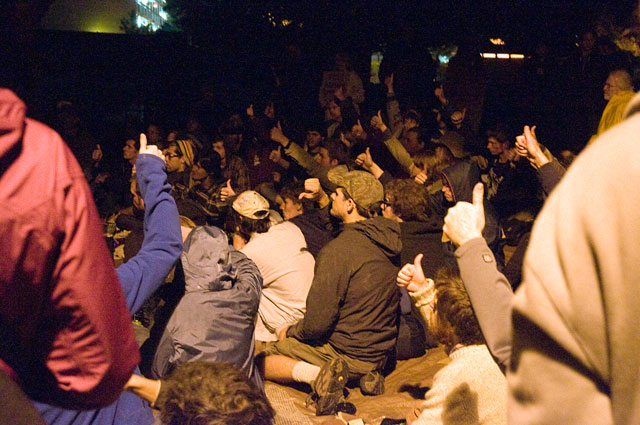
The ideologically mixed crowd remained patient and focused on the speakers Monday evening at the fledgling group’s sixth general assembly meeting. They seemed unfazed by the dizzying array of committees, subcommittees and various interest groups forming. “This is more practical and more functional. They got good practice already from the weekend, and you can see they’re learning,” said Linda Lemaster, a community organizer and one of Monday’s speakers. They discussed whether or not to protest against counter-protestors and Ron Paul supporters. They also covered what to do when police arrive.

“There will be no way to discuss a goddamn thing if there is no protocol for what to do when the police get here!” warned Robert Lewis, a Salinas resident who has been active in camping out. The group eventually decided to leave how to handle the police up to the protestors’ discretion for now.

While the body count has dwindled in the week since the first general meeting in Laurel Park on Tuesday, Oct. 4, there are unmistakable signs that the Occupy Santa Cruz movement is beginning to coalesce after a week of gestation. On Monday morning, Oct. 10, a dozen demonstrators ranging in age from their early twenties to their late sixties sat in camp chairs or milled around the steps of the Santa Cruz County Courthouse.

“The facilitators are getting better,” said Fred Schmidt, adding that while meetings were getting better at staying on track, some members were frustrated at the slow pace imposed by the consensus process. To them, he quoted Jerry Garcia: “‘All good things in good time,’” he said, adding, “Things will happen if you hang out long enough. It’s just the hanging out that takes time.”

The location of the latest demonstration is itself a sign that the group is beginning to focus on its audience. Late last week, protestors were tucked away in San Lorenzo Park; the group decamped for one night to Mission Plaza before re-settling on the courthouse steps on high-traffic Water Street, near the corner of Ocean, and retaining a base in the park.

Many drivers honked or hollered supportive messages to the demonstrators, and several passersby picked signs up to show their support. Two women with young children held official National Nurses United signs that read, “Take it Back. Tax Wall Street;” other handmade signs bearing the messages “Boycott China,” “End the Fed,” and “Stop Funding Wars” were arranged on the steps of the county building.

Scrawled in sharpie on one cardboard sign was a list of demands: free all political prisoners, tax oil companies to pay for healthcare and education, end GMOs, no militarization of the border, end the sleeping ban—a hodgepodge of demands, and a microcosm of a movement that that has become a clearinghouse for grievances.

The Occupy Wall Street movement that began in New York City on Sept. 17 has ignited pockets of collective frustration across the country. At press time, there were 1382 “Occupy” communities registered on the website Meetup.com, the largest in San Francisco, Denver, Phoenix, San Diego, Miami, Fort Lauderdale, Seattle and Portland.

Santa Cruz’s movement started Oct. 4, a drizzly Tuesday, with a crowd that swelled to more than 200 people at Laurel Park. The meeting began with a reading of the manifesto written by Occupy Wall Street before goals specific to Santa Cruz were established.

At times, there was some conflation about where the protestors were directing their anger—some were frustrated at corporations and banks, some blamed city government and the county government, some sloganeered “Vote with your dollars” and others advocated abandoning dollars altogether to subvert the economic hegemony.

A mild-mannered octogenarian proposed occupying the former Borders on Pacific Avenue, a suggestion that was countered with arguments that it would disrupt local businesses and put protestors at a tactical disadvantage to law enforcement. Several other proposals—the Veterans Memorial Hall, Chase Bank on Water Street, the Rittenhouse Building—were raised and voted down before the group finally reached consensus.

The crowed ultimately decided to reconvene Thursday at 10am to occupy the Santa Cruz County Courthouse and San Lorenzo Park. The date, Oct. 6, was chosen in solidarity with other “Occupy” actions happening around the country.

On Thursday morning, protestors began erecting tents in a thicket of oak trees beside the lawn bowling courts in San Lorenzo Park. Literature was distributed among the crowd before the meeting began, including a nine-page handbook titled: “OCCUPY! Your Guide to the International Occupation Movement of 2011” and a map of Downtown Santa Cruz delineating the route Friday’s march would take (Dakota to Laurel to Pacific to Cooper to Front to River to Water to Ocean and back to San Lorenzo Park).

“I think it’s going to be a long process and I know there is a wide range of demands, but two of the things I’d like to see are campaign finance reform and a return to higher taxes like before Reagan,” said Noah Shepherdson, an in-home support services worker who cares for two quadriplegics. “People who are making more than $250,000 a year and paying less than their secretary, that’s just ridiculous.”

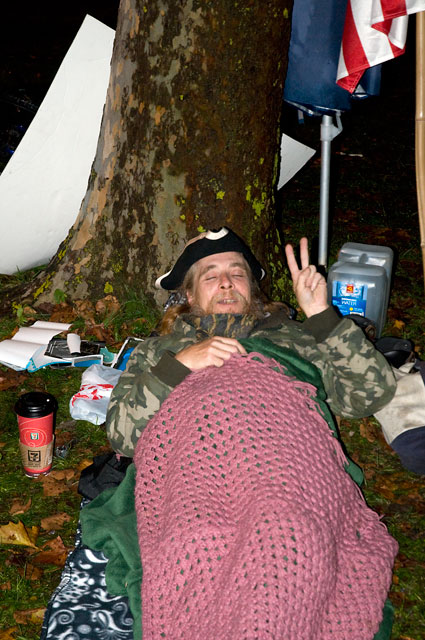
By Monday some of the realities of an extended protest were becoming clear. “It’s hard. It’s not just consensus that’s hard, but sleeping outside on the ground is hard,” said Lemaster, adding that she has hopes the protest will make inroads to connect poor people in Santa Cruz with the rest of the community. It’s already happening, she said, and Rooney, the UCSC grad, concurred.

“Regardless of everyone’s political beliefs, the unifying thread is that economic inequality is unacceptable,” said Rooney, “and that big money still has to be taken down.”

With additional reporting by Jacob Pierce.

Occupy Santa Cruz Learns The Ropes

A movement finds its footing


Read More: News,
By Tessa Stuart Wed, Oct 12, 2011

Credit: Chip Scheuer

‘There are liberals. There are Marxists. There are Libertarians. The beautiful thing is that there is a lot of diversity,” said Occupy Santa Cruz protester Patrick Roooney, a 2010 UCSC graduate.

The ideologically mixed crowd remained patient and focused on the speakers Monday evening at the fledgling group’s sixth general assembly meeting. They seemed unfazed by the dizzying array of committees, subcommittees and various interest groups forming. “This is more practical and more functional. They got good practice already from the weekend, and you can see they’re learning,” said Linda Lemaster, a community organizer and one of Monday’s speakers. They discussed whether or not to protest against counterprotestors and Ron Paul supporters. They also covered what to do when police arrive.

“There will be no way to discuss a goddamn thing if there is no protocol for what to do when the police get here!” warned Robert Lewis, a Salinas resident who has been active in camping out. The group eventually decided to leave how to handle the police up to the protestors’ discretion for now.

While the body count has dwindled in the week since the first general meeting in Laurel Park on Tuesday, Oct. 4, there are unmistakable signs that the Occupy Santa Cruz movement is beginning to coalesce after a week of gestation. On Monday morning, Oct. 10, a dozen demonstrators ranging in age from their early twenties to their late sixties sat in camp chairs or milled around the steps of the Santa Cruz County Courthouse.

“The facilitators are getting better,” said Fred Schmidt, adding that while meetings were getting better at staying on track, some members were frustrated at the slow pace imposed by the consensus process. To them, he quoted Jerry Garcia: “‘All good things in good time,’” he said, adding, “Things will happen if you hang out long enough. It’s just the hanging out that takes time.”

The location of the latest demonstration is itself a sign that the group is beginning to focus on its audience. Late last week, protestors were tucked away in San Lorenzo Park; the group decamped for one night to Mission Plaza before re-settling on the courthouse steps on high-traffic Water Street, near the corner of Ocean, and retaining a base in the park.

Many drivers honked or hollered supportive messages to the demonstrators, and several passersby picked signs up to show their support. Two women with young children held official National Nurses United signs that read, “Take it Back. Tax Wall Street;” other handmade signs bearing the messages “Boycott China,” “End the Fed,” and “Stop Funding Wars” were arranged on the steps of the county building.

Scrawled in sharpie on one cardboard sign was a list of demands: free all political prisoners, tax oil companies to pay for healthcare and education, end GMOs, no militarization of the border, end the sleeping ban—a hodgepodge of demands, and a microcosm of a movement that that has become a clearinghouse for grievances.

The Occupy Wall Street movement that began in New York City on Sept. 17 has ignited pockets of collective frustration across the country. At press time, there were 1382 “Occupy” communities registered on the website Meetup.com, the largest in San Francisco, Denver, Phoenix, San Diego, Miami, Fort Lauderdale, Seattle and Portland.

Santa Cruz’s movement started Oct. 4, a drizzly Tuesday, with a crowd that swelled to more than 200 people at Laurel Park. The meeting began with a reading of the manifesto written by Occupy Wall Street before goals specific to Santa Cruz were established.

At times, there was some conflation about where the protestors were directing their anger—some were frustrated at corporations and banks, some blamed city government and the county government, some sloganeered “Vote with your dollars” and others advocated abandoning dollars altogether to subvert the economic hegemony.

A mild-mannered octogenarian proposed occupying the former Borders on Pacific Avenue, a suggestion that was countered with arguments that it would disrupt local businesses and put protestors at a tactical disadvantage to law enforcement. Several other proposals—the Veterans Memorial Hall, Chase Bank on Water Street, the Rittenhouse Building—were raised and voted down before the group finally reached consensus.

The crowed ultimately decided to reconvene Thursday at 10am to occupy the Santa Cruz County Courthouse and San Lorenzo Park. The date, Oct. 6, was chosen in solidarity with other “Occupy” actions happening around the country.

On Thursday morning, protestors began erecting tents in a thicket of oak trees beside the lawn bowling courts in San Lorenzo Park. Literature was distributed among the crowd before the meeting began, including a nine-page handbook titled: “OCCUPY! Your Guide to the International Occupation Movement of 2011” and a map of Downtown Santa Cruz delineating the route Friday’s march would take (Dakota to Laurel to Pacific to Cooper to Front to River to Water to Ocean and back to San Lorenzo Park).

“I think it’s going to be a long process and I know there is a wide range of demands, but two of the things I’d like to see are campaign finance reform and a return to higher taxes like before Reagan,” said Noah Shepherdson, an in-home support services worker who cares for two quadriplegics. “People who are making more than $250,000 a year and paying less than their secretary, that’s just ridiculous.”

By Monday some of the realities of an extended protest were becoming clear. “It’s hard. It’s not just consensus that’s hard, but sleeping outside on the ground is hard,” said Lemaster, adding that she has hopes the protest will make inroads to connect poor people in Santa Cruz with the rest of the community. It’s already happening, she said, and Rooney, the UCSC grad, concurred.

“Regardless of everyone’s political beliefs, the unifying thread is that economic inequality is unacceptable,” said Rooney, “and that big money still has to be taken down.”

With additional reporting by Jacob Pierce.

Occupy Santa Cruz Learns The Ropes

A movement finds its footing


Read More: News,
By Tessa Stuart Wed, Oct 12, 2011

Credit: Chip Scheuer

‘There are liberals. There are Marxists. There are Libertarians. The beautiful thing is that there is a lot of diversity,” said Occupy Santa Cruz protester Patrick Roooney, a 2010 UCSC graduate.

The ideologically mixed crowd remained patient and focused on the speakers Monday evening at the fledgling group’s sixth general assembly meeting. They seemed unfazed by the dizzying array of committees, subcommittees and various interest groups forming. “This is more practical and more functional. They got good practice already from the weekend, and you can see they’re learning,” said Linda Lemaster, a community organizer and one of Monday’s speakers. They discussed whether or not to protest against counterprotestors and Ron Paul supporters. They also covered what to do when police arrive.

“There will be no way to discuss a goddamn thing if there is no protocol for what to do when the police get here!” warned Robert Lewis, a Salinas resident who has been active in camping out. The group eventually decided to leave how to handle the police up to the protestors’ discretion for now.

While the body count has dwindled in the week since the first general meeting in Laurel Park on Tuesday, Oct. 4, there are unmistakable signs that the Occupy Santa Cruz movement is beginning to coalesce after a week of gestation. On Monday morning, Oct. 10, a dozen demonstrators ranging in age from their early twenties to their late sixties sat in camp chairs or milled around the steps of the Santa Cruz County Courthouse.

“The facilitators are getting better,” said Fred Schmidt, adding that while meetings were getting better at staying on track, some members were frustrated at the slow pace imposed by the consensus process. To them, he quoted Jerry Garcia: “‘All good things in good time,’” he said, adding, “Things will happen if you hang out long enough. It’s just the hanging out that takes time.”

The location of the latest demonstration is itself a sign that the group is beginning to focus on its audience. Late last week, protestors were tucked away in San Lorenzo Park; the group decamped for one night to Mission Plaza before re-settling on the courthouse steps on high-traffic Water Street, near the corner of Ocean, and retaining a base in the park.

Many drivers honked or hollered supportive messages to the demonstrators, and several passersby picked signs up to show their support. Two women with young children held official National Nurses United signs that read, “Take it Back. Tax Wall Street;” other handmade signs bearing the messages “Boycott China,” “End the Fed,” and “Stop Funding Wars” were arranged on the steps of the county building.

Scrawled in sharpie on one cardboard sign was a list of demands: free all political prisoners, tax oil companies to pay for healthcare and education, end GMOs, no militarization of the border, end the sleeping ban—a hodgepodge of demands, and a microcosm of a movement that that has become a clearinghouse for grievances.

The Occupy Wall Street movement that began in New York City on Sept. 17 has ignited pockets of collective frustration across the country. At press time, there were 1382 “Occupy” communities registered on the website Meetup.com, the largest in San Francisco, Denver, Phoenix, San Diego, Miami, Fort Lauderdale, Seattle and Portland.

Santa Cruz’s movement started Oct. 4, a drizzly Tuesday, with a crowd that swelled to more than 200 people at Laurel Park. The meeting began with a reading of the manifesto written by Occupy Wall Street before goals specific to Santa Cruz were established.

At times, there was some conflation about where the protestors were directing their anger—some were frustrated at corporations and banks, some blamed city government and the county government, some sloganeered “Vote with your dollars” and others advocated abandoning dollars altogether to subvert the economic hegemony.

A mild-mannered octogenarian proposed occupying the former Borders on Pacific Avenue, a suggestion that was countered with arguments that it would disrupt local businesses and put protestors at a tactical disadvantage to law enforcement. Several other proposals—the Veterans Memorial Hall, Chase Bank on Water Street, the Rittenhouse Building—were raised and voted down before the group finally reached consensus.

The crowed ultimately decided to reconvene Thursday at 10am to occupy the Santa Cruz County Courthouse and San Lorenzo Park. The date, Oct. 6, was chosen in solidarity with other “Occupy” actions happening around the country.

On Thursday morning, protestors began erecting tents in a thicket of oak trees beside the lawn bowling courts in San Lorenzo Park. Literature was distributed among the crowd before the meeting began, including a nine-page handbook titled: “OCCUPY! Your Guide to the International Occupation Movement of 2011” and a map of Downtown Santa Cruz delineating the route Friday’s march would take (Dakota to Laurel to Pacific to Cooper to Front to River to Water to Ocean and back to San Lorenzo Park).

“I think it’s going to be a long process and I know there is a wide range of demands, but two of the things I’d like to see are campaign finance reform and a return to higher taxes like before Reagan,” said Noah Shepherdson, an in-home support services worker who cares for two quadriplegics. “People who are making more than $250,000 a year and paying less than their secretary, that’s just ridiculous.”

By Monday some of the realities of an extended protest were becoming clear. “It’s hard. It’s not just consensus that’s hard, but sleeping outside on the ground is hard,” said Lemaster, adding that she has hopes the protest will make inroads to connect poor people in Santa Cruz with the rest of the community. It’s already happening, she said, and Rooney, the UCSC grad, concurred.

“Regardless of everyone’s political beliefs, the unifying thread is that economic inequality is unacceptable,” said Rooney, “and that big money still has to be taken down.”

With additional reporting by Jacob Pierce.
Occupy Santa Cruz Learns The Ropes

A movement finds its footing


Read More: News,
By Tessa Stuart Wed, Oct 12, 2011

Credit: Chip Scheuer

‘There are liberals. There are Marxists. There are Libertarians. The beautiful thing is that there is a lot of diversity,” said Occupy Santa Cruz protester Patrick Roooney, a 2010 UCSC graduate.

The ideologically mixed crowd remained patient and focused on the speakers Monday evening at the fledgling group’s sixth general assembly meeting. They seemed unfazed by the dizzying array of committees, subcommittees and various interest groups forming. “This is more practical and more functional. They got good practice already from the weekend, and you can see they’re learning,” said Linda Lemaster, a community organizer and one of Monday’s speakers. They discussed whether or not to protest against counterprotestors and Ron Paul supporters. They also covered what to do when police arrive.

“There will be no way to discuss a goddamn thing if there is no protocol for what to do when the police get here!” warned Robert Lewis, a Salinas resident who has been active in camping out. The group eventually decided to leave how to handle the police up to the protestors’ discretion for now.

While the body count has dwindled in the week since the first general meeting in Laurel Park on Tuesday, Oct. 4, there are unmistakable signs that the Occupy Santa Cruz movement is beginning to coalesce after a week of gestation. On Monday morning, Oct. 10, a dozen demonstrators ranging in age from their early twenties to their late sixties sat in camp chairs or milled around the steps of the Santa Cruz County Courthouse.

“The facilitators are getting better,” said Fred Schmidt, adding that while meetings were getting better at staying on track, some members were frustrated at the slow pace imposed by the consensus process. To them, he quoted Jerry Garcia: “‘All good things in good time,’” he said, adding, “Things will happen if you hang out long enough. It’s just the hanging out that takes time.”

The location of the latest demonstration is itself a sign that the group is beginning to focus on its audience. Late last week, protestors were tucked away in San Lorenzo Park; the group decamped for one night to Mission Plaza before re-settling on the courthouse steps on high-traffic Water Street, near the corner of Ocean, and retaining a base in the park.

Many drivers honked or hollered supportive messages to the demonstrators, and several passersby picked signs up to show their support. Two women with young children held official National Nurses United signs that read, “Take it Back. Tax Wall Street;” other handmade signs bearing the messages “Boycott China,” “End the Fed,” and “Stop Funding Wars” were arranged on the steps of the county building.

Scrawled in sharpie on one cardboard sign was a list of demands: free all political prisoners, tax oil companies to pay for healthcare and education, end GMOs, no militarization of the border, end the sleeping ban—a hodgepodge of demands, and a microcosm of a movement that that has become a clearinghouse for grievances.

The Occupy Wall Street movement that began in New York City on Sept. 17 has ignited pockets of collective frustration across the country. At press time, there were 1382 “Occupy” communities registered on the website Meetup.com, the largest in San Francisco, Denver, Phoenix, San Diego, Miami, Fort Lauderdale, Seattle and Portland.

Santa Cruz’s movement started Oct. 4, a drizzly Tuesday, with a crowd that swelled to more than 200 people at Laurel Park. The meeting began with a reading of the manifesto written by Occupy Wall Street before goals specific to Santa Cruz were established.

At times, there was some conflation about where the protestors were directing their anger—some were frustrated at corporations and banks, some blamed city government and the county government, some sloganeered “Vote with your dollars” and others advocated abandoning dollars altogether to subvert the economic hegemony.

A mild-mannered octogenarian proposed occupying the former Borders on Pacific Avenue, a suggestion that was countered with arguments that it would disrupt local businesses and put protestors at a tactical disadvantage to law enforcement. Several other proposals—the Veterans Memorial Hall, Chase Bank on Water Street, the Rittenhouse Building—were raised and voted down before the group finally reached consensus.

The crowed ultimately decided to reconvene Thursday at 10am to occupy the Santa Cruz County Courthouse and San Lorenzo Park. The date, Oct. 6, was chosen in solidarity with other “Occupy” actions happening around the country.

On Thursday morning, protestors began erecting tents in a thicket of oak trees beside the lawn bowling courts in San Lorenzo Park. Literature was distributed among the crowd before the meeting began, including a nine-page handbook titled: “OCCUPY! Your Guide to the International Occupation Movement of 2011” and a map of Downtown Santa Cruz delineating the route Friday’s march would take (Dakota to Laurel to Pacific to Cooper to Front to River to Water to Ocean and back to San Lorenzo Park).

“I think it’s going to be a long process and I know there is a wide range of demands, but two of the things I’d like to see are campaign finance reform and a return to higher taxes like before Reagan,” said Noah Shepherdson, an in-home support services worker who cares for two quadriplegics. “People who are making more than $250,000 a year and paying less than their secretary, that’s just ridiculous.”

By Monday some of the realities of an extended protest were becoming clear. “It’s hard. It’s not just consensus that’s hard, but sleeping outside on the ground is hard,” said Lemaster, adding that she has hopes the protest will make inroads to connect poor people in Santa Cruz with the rest of the community. It’s already happening, she said, and Rooney, the UCSC grad, concurred.

“Regardless of everyone’s political beliefs, the unifying thread is that economic inequality is unacceptable,” said Rooney, “and that big money still has to be taken down.”

With additional reporting by Jacob Pierce.
Occupy Santa Cruz Learns The Ropes

A movement finds its footing


Read More: News,
By Tessa Stuart Wed, Oct 12, 2011

Credit: Chip Scheuer

‘There are liberals. There are Marxists. There are Libertarians. The beautiful thing is that there is a lot of diversity,” said Occupy Santa Cruz protester Patrick Roooney, a 2010 UCSC graduate.

The ideologically mixed crowd remained patient and focused on the speakers Monday evening at the fledgling group’s sixth general assembly meeting. They seemed unfazed by the dizzying array of committees, subcommittees and various interest groups forming. “This is more practical and more functional. They got good practice already from the weekend, and you can see they’re learning,” said Linda Lemaster, a community organizer and one of Monday’s speakers. They discussed whether or not to protest against counterprotestors and Ron Paul supporters. They also covered what to do when police arrive.

“There will be no way to discuss a goddamn thing if there is no protocol for what to do when the police get here!” warned Robert Lewis, a Salinas resident who has been active in camping out. The group eventually decided to leave how to handle the police up to the protestors’ discretion for now.

While the body count has dwindled in the week since the first general meeting in Laurel Park on Tuesday, Oct. 4, there are unmistakable signs that the Occupy Santa Cruz movement is beginning to coalesce after a week of gestation. On Monday morning, Oct. 10, a dozen demonstrators ranging in age from their early twenties to their late sixties sat in camp chairs or milled around the steps of the Santa Cruz County Courthouse.

“The facilitators are getting better,” said Fred Schmidt, adding that while meetings were getting better at staying on track, some members were frustrated at the slow pace imposed by the consensus process. To them, he quoted Jerry Garcia: “‘All good things in good time,’” he said, adding, “Things will happen if you hang out long enough. It’s just the hanging out that takes time.”

The location of the latest demonstration is itself a sign that the group is beginning to focus on its audience. Late last week, protestors were tucked away in San Lorenzo Park; the group decamped for one night to Mission Plaza before re-settling on the courthouse steps on high-traffic Water Street, near the corner of Ocean, and retaining a base in the park.

Many drivers honked or hollered supportive messages to the demonstrators, and several passersby picked signs up to show their support. Two women with young children held official National Nurses United signs that read, “Take it Back. Tax Wall Street;” other handmade signs bearing the messages “Boycott China,” “End the Fed,” and “Stop Funding Wars” were arranged on the steps of the county building.

Scrawled in sharpie on one cardboard sign was a list of demands: free all political prisoners, tax oil companies to pay for healthcare and education, end GMOs, no militarization of the border, end the sleeping ban—a hodgepodge of demands, and a microcosm of a movement that that has become a clearinghouse for grievances.

The Occupy Wall Street movement that began in New York City on Sept. 17 has ignited pockets of collective frustration across the country. At press time, there were 1382 “Occupy” communities registered on the website Meetup.com, the largest in San Francisco, Denver, Phoenix, San Diego, Miami, Fort Lauderdale, Seattle and Portland.

Santa Cruz’s movement started Oct. 4, a drizzly Tuesday, with a crowd that swelled to more than 200 people at Laurel Park. The meeting began with a reading of the manifesto written by Occupy Wall Street before goals specific to Santa Cruz were established.

At times, there was some conflation about where the protestors were directing their anger—some were frustrated at corporations and banks, some blamed city government and the county government, some sloganeered “Vote with your dollars” and others advocated abandoning dollars altogether to subvert the economic hegemony.

A mild-mannered octogenarian proposed occupying the former Borders on Pacific Avenue, a suggestion that was countered with arguments that it would disrupt local businesses and put protestors at a tactical disadvantage to law enforcement. Several other proposals—the Veterans Memorial Hall, Chase Bank on Water Street, the Rittenhouse Building—were raised and voted down before the group finally reached consensus.

The crowed ultimately decided to reconvene Thursday at 10am to occupy the Santa Cruz County Courthouse and San Lorenzo Park. The date, Oct. 6, was chosen in solidarity with other “Occupy” actions happening around the country.

On Thursday morning, protestors began erecting tents in a thicket of oak trees beside the lawn bowling courts in San Lorenzo Park. Literature was distributed among the crowd before the meeting began, including a nine-page handbook titled: “OCCUPY! Your Guide to the International Occupation Movement of 2011” and a map of Downtown Santa Cruz delineating the route Friday’s march would take (Dakota to Laurel to Pacific to Cooper to Front to River to Water to Ocean and back to San Lorenzo Park).

“I think it’s going to be a long process and I know there is a wide range of demands, but two of the things I’d like to see are campaign finance reform and a return to higher taxes like before Reagan,” said Noah Shepherdson, an in-home support services worker who cares for two quadriplegics. “People who are making more than $250,000 a year and paying less than their secretary, that’s just ridiculous.”

By Monday some of the realities of an extended protest were becoming clear. “It’s hard. It’s not just consensus that’s hard, but sleeping outside on the ground is hard,” said Lemaster, adding that she has hopes the protest will make inroads to connect poor people in Santa Cruz with the rest of the community. It’s already happening, she said, and Rooney, the UCSC grad, concurred.

“Regardless of everyone’s political beliefs, the unifying thread is that economic inequality is unacceptable,” said Rooney, “and that big money still has to be taken down.”

With additional reporting by Jacob Pierce.

Sunday, October 9, 2011

The Banks Are Made of Marble, With A Guard At Every Door

To Occupy Santa Cruz, Occupy Wall Street, all my occupying children and brothers and sisters in the US of A and beyond ... restorative justice! Demand that people who stole and cheated and lied to us about it and then told our Congress when it tried to investigate: "you can't stop us because you don't understand money, "its complicated", you need us, or else we will rip up the world economy ...with these powerful HORNS of other peoples' plenty: give us welfare, pay us for our crimes". Don't forget all those Corporate Board members of many corporations, who did their directorial jobs as tho' America was a craps table in Reno and the rest of the world, just five dollar coins to dicker with. Fundamental ethics does not require greater regulation. The Golden Parachute crowd gets a BIG Fail from me. Stealing peoples' lives just to look awesome to one's buddies. NO MORE. Close the banks STILL run by felonious heartless freaks.
Linda's Hearth note: will dress this up w/headlines, photo later

Saturday, October 8, 2011

October 8 ~ Occupy Santa Cruz, Glimpses

Last Night at OCCUPY SANTA CRUZ

by Alex Darocy Friday Oct 7th, 2011 2:38 AM
occupy-santa-cruz-17.jpg

General Assembly
by Alex Darocy Friday Oct 7th, 2011 2:38 AM
chris-doyon-occupy-santa-cruz-18.jpg
chris-doyon-occupy-santa-...

Chris Doyon.

Friday, October 7, 2011

October 7 Beach Gift to Occupy Santa Cruz

Occupy Santa Cruz, a Tidal Offering

This morning at Twin Lakes Beach, P-sign Paul gives a big thumbs up to OSC as the sun shines and our momentum builds

This morning at Twin Lakes Beach, P-sign Paul gives a big thumbs up to #OccupySantaCruz as the sun shines and our momentum builds.

This morning at Twin Lakes Beach, P-sign Paul gives a big thumbs up to #OccupySantaCruz as the sun shines and our momentum builds.

Wednesday, October 5, 2011

He was unique. His own person. Our own person.

Steve Jobs Is Dead

Steve Jobs is dead. The Apple chairman and former CEO who made personal computers, smartphones, tablets, and digital animation mass-market products passed away today. We're going to miss him. Deeply, and personally.

Steven P. Jobs passed away on October 5th, 2011 after a long struggle with pancreatic cancer. He was just 56 years old. We mourn his passing, and wish his family the very best.

Let's address this up front: Gizmodo and Steve Jobs had, at best, a tumultuous relationship. Yet no matter how much he may have hated us, we admired him.

No, that's not quite right. We loved him.

He was the reason many of us got into this industry, or even care about technology at all. He made the computer personal, and the smartphone fun. Bill Gates may have put a computer on every office desk, but it was Steve Jobs who put one in every dorm room and bedroom and living room. And then, years later, he repeated the trick, putting one in every bag and every pocket, thanks to the iPad and iPhone. If you use a computer or smartphone today, it is either one he created, or an imitation of his genius.

He changed the way movies are made, the way music is sold, the way stories are told, the very way we interact with the world around us. He helped us work, and gave us new ways to play. He was a myth made man.

Prior to Steve Jobs, computers were alien to most of us. They were accessible to few people without an engineering degree. Not merely because of their complex operating procedures, but also because they were so cold and so inhuman. Jobs understood that they could be something more than that. That while computers would never be people, he could endow them with humanity. He could transform them into machines that not only anyone could use, but that everyday people would enjoy using thanks to the art of great design. He made them something that would be part of our lives. And he did that again and again.

His life story is familiar, but it deserves repeating. He was given up for adoption by his unmarried parents. He grew up in California, and was very much a product of that place and time. He took drugs. He got into phone hacking. Both were precursers to what would always be his interest: changing the status quo.

In 1976 he started Apple in a garage. Together with Steve Wozniak, he shipped the first true fully-built personal computer, the Apple I. He drove development of the Mac, understanding that it was the future of computers. The great thing that we would all see. He brought in a grown up to run the company. And that grown up forced him out of the company that he built and into the wilderness.

While he was gone, he started NeXT computer. The NeXT operating system would form the underpinnings of Apple's OS X, and iOS.

He also started the best movie studio of the past 30 years. Pixar's films were innovative, to be sure. It pushed the boundaries of CGI to such an extent that even today its early films still look great. But technology is only a tool. As with everything else he understood that great technology alone is not enough. It must be human to have an impact. Pixar movies tell stories. They make grown men cry. That was the impact of Steve Jobs.

He became a family man. He reunited with his biological mother, and his sister, the writer Mona Simpson. He married. He had children. He was, by all accounts, a great dad. It was his role as husband and father that helped drive his second act at Apple.

After his return to Apple, the company began shipping iconic product after iconic product. Products that defined a decade. The iMac, OS X, the iPod, iTunes (which was very good, before it was very bad), the iPhone, the iPad. All of these were deeply human products. They reflected his understanding of how technology was used not only in the workplace, but in the home. In his keynotes, product demos typically showed not executives, but families.

He made Apple into the most valuable company in the world.

He never met his biological father.

He accomplished so many things, in so many fields that it's tempting to compare Jobs to someone from the past. A Thomas Edison or a Ben Franklin or even a Leonardo Da Vinci. We tend to do that because it helps us understand. But it does him a disservice. He was unique. His own person. Our own person.

He was our emblematic genius. In 100 years, when historians talk about the emergence of the age of intelligent machines, it is Steve Jobs they will hold up as the great exemplar of our era.

They will remember his flaws, too. When Atari hired Jobs and Woz to write the code for the iconic Atari game Breakout, the pair earned a $5000 bonus for completing the work, largely done by Woz. But Jobs kept the bonus a secret, and only paid his partner $375. When his daughter Lisa was born in 1978, he spent two years denying he was her father. His denials forced her and her mother to support themselves on welfare. In the workplace he's often been described as temperamental and even petulant. He could be arrogant and unforgiving.

He was not a god. He was simply a man.

Yet for all his faults, he changed the world. He made it better.

He once famously asked of a critic "what have you done that's so great?" For Jobs, the answer to that question was very nearly unlimited.

Our world will be less interesting, less exciting, and less meaningful without him.

Goodbye, Mr. Jobs. We will miss you so very much.


Linda's Hearth note: thank you to Thomas Leavitt for sharing this obituary.


Tuesday, October 4, 2011

#Occupy -Santa Cruz gathering to support Wall Street demonstrators and the cities following...

Occupy Santa Cruz - General Assembly
Tuesday October 4, 2011
5:00 PM - 8:00 PM

Laurel Park 301 Center St. behind Louden Nelson Community Center
occupysantacruz@gmail.com


We are doing this... and need your help. We are the 99%. And so are you.

We will gather to hold our first meeting and general assembly at 5PM on Tuesday, October 4th to bring together energy, ideas and skills/interest to help shift the movement forward in our local area. If you can't make it right at 5pm, come when you can!

Bring your ideas for actions to be decided on as a group. Bring flyers, cameras, notepads/cardboard and markers! Share this everywhere to make sure everyone who would want to know, knows. We need YOU! We will make plans and decisions around the best way to peacefully protest in Santa Cruz.

In the meantime, if you have experience organizing, protesting, designing flyers, or an insane amount of passion, email us! If you want to put flyers up, or help spread the word in any other way, PLEASE do. The time is now. Let's show the big corporations that we do NOT accept their ownership of OUR Nation and show Occupy Wall Street that we support them to the end.

Stream live coverage from "Occupy Wall Street" here: http://www.livestream.com/globalrevolution/

Santa Cruz FB Page:
http://www.facebook.com/OccupySantaCruz

Santa Cruz Twitter Page:
http://twitter.com/#!/OccupySantaCruz

Occupy Wall Street:
http://www.occupywallstreet.org/
http://www.facebook.com/OccupyWallSt

Occupy Wall Street is a people powered movement for democracy that began in America on September 17 with an encampment in the financial district of New York City. Inspired by the Egyptian Tahrir Square uprising and the Spanish acampadas.

On September 17th, men and women of all races, backgrounds, political and religious beliefs, began to organize in nonviolent protest. These men and women represent the 99% with the goal of ending the greed and corruption of the wealthiest 1% of America. Occupy Wall Street is a leaderless resistance movement which began as a call to action from Adbusters, a Canadian-based anti-consumerist organization.

The original projections for the protest were to be between 20,000–90,000 participants. However, when only a little over a thousand protestors showed up the first day, it was labeled a bust. In the days to follow, more and more people have joined the protestors as they spend day and night in Liberty Square.

As stated by Occupy Wall Street:

“The beauty of this new formula, and what makes this novel tactic exciting, is its pragmatic simplicity: we talk to each other in various physical gatherings and virtual people’s assemblies … we zero in on what our one demand will be, a demand that awakens the imagination and, if achieved, would propel us toward the radical democracy of the future … and then we go out and seize a square of singular symbolic significance and put our asses on the line to make it happen.”

Linda's Hearth note: I don't know if I can attend, but am interested and hope to follow events. Thanks to The Spoon for this announcement to SCPEL list! As Mother Jones famously said, "Pray for the dead and fight like hell for the living."!