Friday, October 14, 2011

Occupy Together ~~ every sunrise is a new success

For Wall Street Protests, What Constitutes Success?

Demonstrators associated with the Occupy Wall Street movement face off with police Friday in the streets of New York City's financial district.
Spencer Platt/Getty Images

Demonstrators associated with the Occupy Wall Street movement face off with police Friday in the streets of New York City's financial district.


Wall Street protesters avoided a showdown Friday that could have forced them from their Manhattan camp, but they still face the same question that would have confronted them if they had been evicted: Where do they go from here?

The Occupy Wall Street movement has been more successful than even its own organizers would have predicted when they began nearly a month ago. The New York City protest has shown staying power, garnered considerable media attention and inspired satellite protests in more than 100 cities nationwide.

````````Movements don't write legislation. They force open a line of questions that makes it ````````possible for people to imagine new policies. That's always the first step.

Demonstrators have been criticized, largely by conservative politicians and pundits, for questioning institutions — mainly the financial industry and the very wealthy — that loom large in American society. Even sympathetic observers wonder whether the protesters can convert their message of unhappiness about income inequality into policies that actually lead to change.

"The first step of these things is to mobilize community and energy, but at some point that energy and strong feelings have to be focused on what you can actually do to change what it is they don't like," says Robert Thompson, a professor of popular culture at Syracuse University.

Eventually, the protesters will have to build alliances with politicians and institutional forces that, in these early days, they have sometimes spurned. But it's premature to expect them to have a clear agenda at this point, say scholars who have studied past protest movements.

"What starts these movements is a list of grievances," says Rosemary Feurer, a historian at Northern Illinois University. "You don't start with a list of goals, but with a sense of what's wrong."

First, Define The Problem

That's what happened in the past, Feurer says. The populist movements of the 19th century and the early union movement began in a similar fashion: An encampment of people came together, found they shared a sense of dissatisfaction with the status quo and worked to change it.

Figuring out how best to express those complaints — and what action to take — always takes time.

American Mad

A selected list of past American protest movements that had a lasting impact.

Civil rights groups picketed a meeting of the board of education in downtown St. Louis in June 1963 to protest integration policies in public schools.
AP

Civil rights groups picketed a meeting of the board of education in downtown St. Louis in June 1963 to protest integration policies in public schools.

Abolitionism: Nineteenth-century demands for an end to slavery helped bring about the Civil War and emancipation.

Populism: Farmers and other working people pushed an early "anti-Wall Street" agenda that worked to break up monopoly power.

Unions: The labor movement of the 19th and early 20th centuries gave rise to strikes and proposals such as an eight-hour work day.

Bonus Army: A 1932 encampment in Washington, D.C., of World War I veterans seeking payment for military service; symbolic of the revived labor movement of the 1930s.

Civil Rights: A nonviolent movement that peaked in the 1960s with laws providing equal public access and voting rights for African-Americans; helped inspire feminists, Hispanics and gay rights movements.

Vietnam: The war inspired mass protests on campuses and elsewhere in the 1960s and 1970s.

Tea Party: The conservative movement coalesced around anti-government feelings beginning in 2009 and quickly became influential with the Republican Party.

— Alan Greenblatt

"The practical matter here is that where there will be actual, let's say, specific policy requests we'll be working toward, those have to come out of a discussion of the group that is organic and consensus-driven," says Ed Needham, a media spokesman for Occupy Wall Street.

"We're doing our best to define who we are at the moment," he says. "Once we are able to do that, we can do things on the policy front."

Protesting, Not Legislating

If the Wall Street and other Occupy protests are going to lead to real change, activists will have to adopt both an "outside" and an "inside" strategy, says Michael Kazin, a historian at Georgetown University.

They need to keep pushing from outside the normal political channels, but they also have to learn how to work inside those channels, whether by helping create new institutions with a clear agenda that reflects their goals or, more likely, by working hand-in-glove with existing institutions.

It may take awhile to articulate an actual five-point plan that leads to, say, a greater distribution of wealth. And if history is any guide, such a plan may not come out of the protest movement directly, but from politicians responding to it.

"The concrete success, the actual reforms or changes in the system that result from something like this, don't come from the protest movements themselves," says Ruy Teixeira, a senior fellow with the Center for American Progress, a liberal think tank in Washington, D.C.

Already, Occupy Wall Street has won support from important institutions on the left such as the AFL-CIO, which urged members to mobilize to prevent protesters from being ousted from Zuccotti Park. But the movement has puzzled political observers by seeming to turn away other forms of help.

When Rep. John Lewis showed up last week to address the crowd at the Occupy Atlanta site, protesters praised the Georgia Democrat for his work in politics and civil rights but successfully argued that he shouldn't be allowed to bump the group's "agenda" in order to speak right away.

Lewis, who had other obligations, decided to leave, though he said he took no offense. Recalling his own days as head of the Student Nonviolent Coordinating Committee in the 1960s, he said civil rights groups sometimes reached consensus slowly and refused to be deferential to more established leaders.

"It is growing, it is maturing, it will work out," Lewis told reporters at the scene. "It will come of age."

Building Up Support

It may, at any rate, be premature for Occupy Wall Street to join hands with politicians, according to Feurer, the Northern Illinois historian. "The movement has to grow before it can be politically effective," she says.

The protests, however sustained and widespread, are not yet large enough to amount to a real reflection of public opinion.

But the mere fact that more people are talking about income inequality and the growing share of wealth controlled by the nation's richest 1 percent represents a type of victory, says Nina Eliasoph, a sociologist at the University of Southern California.

"Movements don't write legislation," she says. "They force open a line of questions that makes it possible for people to imagine new policies. That's always the first step."

When protests appear to be successful and express important ideas, some people will want to sustain them by moving past street theater toward affecting actual policy changes, says Kazin, the Georgetown historian and author of American Dreamers: How the Left Changed a Nation.

"This always happens with protests that get large. People say, 'This is wonderful and I want to do something with this,' and they become professional activists of one form or another," Kazin says. "Believe it or not, you end up having organizations."

Related NPR Stories

Thursday, October 13, 2011

from Hearts and Minds to Occupy Everywhere

An Open Letter to the Occupiers from a Veteran Troublemaker

by Jim Wallis


Throughout history, often it has been left to the youth of a society to do that, and you boldly have stepped into the role of the emerging generation, which sometimes means saying and doing what others only think. You have articulated, loudly and clearly, the internal monologue of a nation.

Some of you have told me that you expected only to foment a short-lived protest and that you were as surprised by this "movement" as anyone else. Try to listen and learn from those whose feelings and participation you are evoking by encouraging more reflection than certainty.

While there are some among us who may misunderstand your motives and message, know that you are an inspiration to many more.

One of you told me in New York City last week, "This is not a protest, but a think tank." Another of your compatriots wanted me to understand that you are trying to build something in Liberty Square that you aspire to create for our global village -- a more cooperative society.

Most telling to me was the answer to the first question I asked of the first person I talked to at the Wall Street demonstrations. I inquired of one of the non-leaders who helped lead the first days of Occupation what most drew him to get involved in the demonstration, and he replied, "I want to have children someday, and this is becoming a world not good for children."

My 13- and 8-year-old boys came to mind when I heard his answer, and I felt thankful. It is precisely those deepest, most authentic feelings and motivations that should preoccupy you, rather than how best to form and communicate superficial political rhetoric.

You are raising very basic questions about an economy that has become increasingly unfair, unstable, unsustainable, and unhappy for a growing number of people. Those same questions are being asked by many others at the bottom, the middle, and even some at the top of the economic pecking order.

There are ethics to be named here, and the transition from the pseudo-ethic of endless growth to the moral ethics of sustainability is a conversation occurring even now in our nation’s business schools (if, perhaps, secreted inside the official curriculum).

Keep pressing those values questions because they will move people more than a set of demands or policy suggestions. Those can and must come later.

And try not to demonize those you view as opponents, as good people can get trapped in bad systems and we've seen a lot of that. Still, you are right for saying that we all must be held accountable -- both systems and the individuals within them. It is imperative that we hear that message right now.

The new safe spaces you have created to ask fundamental questions, now in hundreds of locations around the country and the world, are helping to carve out fresh societal space to examine ourselves -- who we are, what we value most, and where we want to go from here.

Instead of simply attacking the establishment "economists," you can become the citizen economists, like the young economics major I met at the Wall Street occupation who discussed with me new approaches for society’s investment and innovation. We desperately need new vision like hers to come up with alternative ways of performing essential functions.

Keep asking what a just economy should look like and whom it should be for. They are noble questions. But you’d do well to avoid Utopian dreaming about things that will never happen. Look instead at how we could do things differently, more responsibly, more equitably, and yes, more democratically.

Don’t be afraid to get practical and specific about how we can and must do things better than we have in recent years. One of our best moral economists, Amartya Sen, says that "being against the market is like being against conversation. It's a form of exchange." You have begun such a conversation about what markets could and should be. Keep talking.

Even in forums where business and political leaders meet, they too are asking those questions and using terms like "a moral economy" as a way to interrogate our present and failed practices. I’ve been in such a gathering this week -- just days apart from visiting yours -- where the participants slept on featherbedding in five-star hotels rather than in pup tents on the sidewalk. And yet, surprisingly, they were asking many of the same questions you are.

Keep driving both the moral and practical questions about the economics of our local and global households, for that is what the discipline was supposed to be about in the first place.

I know you believe that the leadership on Wall Street, and Constitution and Pennsylvania Avenues have all failed you. Indeed, they have failed us all. But while you feel betrayed by both our business and political leaders, don’t give up on leadership per se.

We need innovative leadership now more than ever. And you are providing some of it.

Think of stewards rather than masters of the universe as the model for leadership.

And remember, non-violence is not just a critical tactic but a necessary commitment to moral and civil discourse that can awaken the best in all of us. There is much to be angry about, but channeling that energy into creative, non-violent action is the only way to prevent dangerous cynicism and nihilism that also can be a human response to the injustice and marginalization many people now feel.

The anarchism of anger has never produced the change that the discipline and constructive program of non-violent movements has done again and again.

I remember what it feels like to see your movement as a lead story on the evening news every night, and the adrenaline rush that being able to muster 10,000 people in two hours' time to march in protest against injustice and inhumanity can bring. I was in your shoes 40 years ago as a student leading demonstrations against the Vietnam War, racism, and nuclear proliferation.

I would advise you to cultivate humility more than overconfidence or self indulgence. This really is not about you. It's about the marginalized masses, the signs of the times, and the profound yearning for lasting change. Take that larger narrative more seriously than you take yourselves.

Finally, do not let go of your hope. Popular movements are the only force that truly brings about change in society. The established order is never as secure and impervious to change as those who preside over it believe it to be.

Remember that re-action is never as powerful as re-construction. And whatever you may think of organized religion, please keep in mind that change requires spiritual as well as political resources, and that invariably any new economy will be accompanied by a new (or very old) spirituality.

So I will say, may God bless you and keep you.

May God be gracious to you and give you -– and all of us -- peace.

Jim Wallis is the author of Rediscovering Values: A Guide for Economic and Moral Recovery, and CEO of Sojourners. He blogs at www.godspolitics.com. Follow Jim on Twitter @JimWallis.

Wednesday, October 12, 2011

...righteousness like an everflowing stream

"Even though you offer me your burnt offerings and grain offerings, I will not accept them; and the offerings of well-being of your fatted animals I will not look upon. Take away from me the noise of your songs; I will not listen to the melody of your harps. But let justice roll down like waters; and righteousness like an ever-flowing stream."

- Amos 5:22-24

SC Weekly Reviews Week-young Occupy Santa Cruz

Occupy Santa Cruz Learns The Ropes

By Tessa Stuart, with additional reporting by Jacob Pierce

Wed, Oct 12, 2011

A movement finds its footing

‘There are liberals. There are Marxists. There are Libertarians. The beautiful thing is that there is a lot of diversity,” said Occupy Santa Cruz protester Patrick Roooney, a 2010 UCSC graduate.

The ideologically mixed crowd remained patient and focused on the speakers Monday evening at the fledgling group’s sixth general assembly meeting. They seemed unfazed by the dizzying array of committees, subcommittees and various interest groups forming. “This is more practical and more functional. They got good practice already from the weekend, and you can see they’re learning,” said Linda Lemaster, a community organizer and one of Monday’s speakers. They discussed whether or not to protest against counter-protestors and Ron Paul supporters. They also covered what to do when police arrive.

“There will be no way to discuss a goddamn thing if there is no protocol for what to do when the police get here!” warned Robert Lewis, a Salinas resident who has been active in camping out. The group eventually decided to leave how to handle the police up to the protestors’ discretion for now.

While the body count has dwindled in the week since the first general meeting in Laurel Park on Tuesday, Oct. 4, there are unmistakable signs that the Occupy Santa Cruz movement is beginning to coalesce after a week of gestation. On Monday morning, Oct. 10, a dozen demonstrators ranging in age from their early twenties to their late sixties sat in camp chairs or milled around the steps of the Santa Cruz County Courthouse.

“The facilitators are getting better,” said Fred Schmidt, adding that while meetings were getting better at staying on track, some members were frustrated at the slow pace imposed by the consensus process. To them, he quoted Jerry Garcia: “‘All good things in good time,’” he said, adding, “Things will happen if you hang out long enough. It’s just the hanging out that takes time.”

The location of the latest demonstration is itself a sign that the group is beginning to focus on its audience. Late last week, protestors were tucked away in San Lorenzo Park; the group decamped for one night to Mission Plaza before re-settling on the courthouse steps on high-traffic Water Street, near the corner of Ocean, and retaining a base in the park.

Many drivers honked or hollered supportive messages to the demonstrators, and several passersby picked signs up to show their support. Two women with young children held official National Nurses United signs that read, “Take it Back. Tax Wall Street;” other handmade signs bearing the messages “Boycott China,” “End the Fed,” and “Stop Funding Wars” were arranged on the steps of the county building.

Scrawled in sharpie on one cardboard sign was a list of demands: free all political prisoners, tax oil companies to pay for healthcare and education, end GMOs, no militarization of the border, end the sleeping ban—a hodgepodge of demands, and a microcosm of a movement that that has become a clearinghouse for grievances.

The Occupy Wall Street movement that began in New York City on Sept. 17 has ignited pockets of collective frustration across the country. At press time, there were 1382 “Occupy” communities registered on the website Meetup.com, the largest in San Francisco, Denver, Phoenix, San Diego, Miami, Fort Lauderdale, Seattle and Portland.

Santa Cruz’s movement started Oct. 4, a drizzly Tuesday, with a crowd that swelled to more than 200 people at Laurel Park. The meeting began with a reading of the manifesto written by Occupy Wall Street before goals specific to Santa Cruz were established.

At times, there was some conflation about where the protestors were directing their anger—some were frustrated at corporations and banks, some blamed city government and the county government, some sloganeered “Vote with your dollars” and others advocated abandoning dollars altogether to subvert the economic hegemony.

A mild-mannered octogenarian proposed occupying the former Borders on Pacific Avenue, a suggestion that was countered with arguments that it would disrupt local businesses and put protestors at a tactical disadvantage to law enforcement. Several other proposals—the Veterans Memorial Hall, Chase Bank on Water Street, the Rittenhouse Building—were raised and voted down before the group finally reached consensus.

The crowed ultimately decided to reconvene Thursday at 10am to occupy the Santa Cruz County Courthouse and San Lorenzo Park. The date, Oct. 6, was chosen in solidarity with other “Occupy” actions happening around the country.

On Thursday morning, protestors began erecting tents in a thicket of oak trees beside the lawn bowling courts in San Lorenzo Park. Literature was distributed among the crowd before the meeting began, including a nine-page handbook titled: “OCCUPY! Your Guide to the International Occupation Movement of 2011” and a map of Downtown Santa Cruz delineating the route Friday’s march would take (Dakota to Laurel to Pacific to Cooper to Front to River to Water to Ocean and back to San Lorenzo Park).

“I think it’s going to be a long process and I know there is a wide range of demands, but two of the things I’d like to see are campaign finance reform and a return to higher taxes like before Reagan,” said Noah Shepherdson, an in-home support services worker who cares for two quadriplegics. “People who are making more than $250,000 a year and paying less than their secretary, that’s just ridiculous.”

By Monday some of the realities of an extended protest were becoming clear. “It’s hard. It’s not just consensus that’s hard, but sleeping outside on the ground is hard,” said Lemaster, adding that she has hopes the protest will make inroads to connect poor people in Santa Cruz with the rest of the community. It’s already happening, she said, and Rooney, the UCSC grad, concurred.

“Regardless of everyone’s political beliefs, the unifying thread is that economic inequality is unacceptable,” said Rooney, “and that big money still has to be taken down.”

With additional reporting by Jacob Pierce.

Occupy Santa Cruz Learns The Ropes

A movement finds its footing


Read More: News,
By Tessa Stuart Wed, Oct 12, 2011

Credit: Chip Scheuer

‘There are liberals. There are Marxists. There are Libertarians. The beautiful thing is that there is a lot of diversity,” said Occupy Santa Cruz protester Patrick Roooney, a 2010 UCSC graduate.

The ideologically mixed crowd remained patient and focused on the speakers Monday evening at the fledgling group’s sixth general assembly meeting. They seemed unfazed by the dizzying array of committees, subcommittees and various interest groups forming. “This is more practical and more functional. They got good practice already from the weekend, and you can see they’re learning,” said Linda Lemaster, a community organizer and one of Monday’s speakers. They discussed whether or not to protest against counterprotestors and Ron Paul supporters. They also covered what to do when police arrive.

“There will be no way to discuss a goddamn thing if there is no protocol for what to do when the police get here!” warned Robert Lewis, a Salinas resident who has been active in camping out. The group eventually decided to leave how to handle the police up to the protestors’ discretion for now.

While the body count has dwindled in the week since the first general meeting in Laurel Park on Tuesday, Oct. 4, there are unmistakable signs that the Occupy Santa Cruz movement is beginning to coalesce after a week of gestation. On Monday morning, Oct. 10, a dozen demonstrators ranging in age from their early twenties to their late sixties sat in camp chairs or milled around the steps of the Santa Cruz County Courthouse.

“The facilitators are getting better,” said Fred Schmidt, adding that while meetings were getting better at staying on track, some members were frustrated at the slow pace imposed by the consensus process. To them, he quoted Jerry Garcia: “‘All good things in good time,’” he said, adding, “Things will happen if you hang out long enough. It’s just the hanging out that takes time.”

The location of the latest demonstration is itself a sign that the group is beginning to focus on its audience. Late last week, protestors were tucked away in San Lorenzo Park; the group decamped for one night to Mission Plaza before re-settling on the courthouse steps on high-traffic Water Street, near the corner of Ocean, and retaining a base in the park.

Many drivers honked or hollered supportive messages to the demonstrators, and several passersby picked signs up to show their support. Two women with young children held official National Nurses United signs that read, “Take it Back. Tax Wall Street;” other handmade signs bearing the messages “Boycott China,” “End the Fed,” and “Stop Funding Wars” were arranged on the steps of the county building.

Scrawled in sharpie on one cardboard sign was a list of demands: free all political prisoners, tax oil companies to pay for healthcare and education, end GMOs, no militarization of the border, end the sleeping ban—a hodgepodge of demands, and a microcosm of a movement that that has become a clearinghouse for grievances.

The Occupy Wall Street movement that began in New York City on Sept. 17 has ignited pockets of collective frustration across the country. At press time, there were 1382 “Occupy” communities registered on the website Meetup.com, the largest in San Francisco, Denver, Phoenix, San Diego, Miami, Fort Lauderdale, Seattle and Portland.

Santa Cruz’s movement started Oct. 4, a drizzly Tuesday, with a crowd that swelled to more than 200 people at Laurel Park. The meeting began with a reading of the manifesto written by Occupy Wall Street before goals specific to Santa Cruz were established.

At times, there was some conflation about where the protestors were directing their anger—some were frustrated at corporations and banks, some blamed city government and the county government, some sloganeered “Vote with your dollars” and others advocated abandoning dollars altogether to subvert the economic hegemony.

A mild-mannered octogenarian proposed occupying the former Borders on Pacific Avenue, a suggestion that was countered with arguments that it would disrupt local businesses and put protestors at a tactical disadvantage to law enforcement. Several other proposals—the Veterans Memorial Hall, Chase Bank on Water Street, the Rittenhouse Building—were raised and voted down before the group finally reached consensus.

The crowed ultimately decided to reconvene Thursday at 10am to occupy the Santa Cruz County Courthouse and San Lorenzo Park. The date, Oct. 6, was chosen in solidarity with other “Occupy” actions happening around the country.

On Thursday morning, protestors began erecting tents in a thicket of oak trees beside the lawn bowling courts in San Lorenzo Park. Literature was distributed among the crowd before the meeting began, including a nine-page handbook titled: “OCCUPY! Your Guide to the International Occupation Movement of 2011” and a map of Downtown Santa Cruz delineating the route Friday’s march would take (Dakota to Laurel to Pacific to Cooper to Front to River to Water to Ocean and back to San Lorenzo Park).

“I think it’s going to be a long process and I know there is a wide range of demands, but two of the things I’d like to see are campaign finance reform and a return to higher taxes like before Reagan,” said Noah Shepherdson, an in-home support services worker who cares for two quadriplegics. “People who are making more than $250,000 a year and paying less than their secretary, that’s just ridiculous.”

By Monday some of the realities of an extended protest were becoming clear. “It’s hard. It’s not just consensus that’s hard, but sleeping outside on the ground is hard,” said Lemaster, adding that she has hopes the protest will make inroads to connect poor people in Santa Cruz with the rest of the community. It’s already happening, she said, and Rooney, the UCSC grad, concurred.

“Regardless of everyone’s political beliefs, the unifying thread is that economic inequality is unacceptable,” said Rooney, “and that big money still has to be taken down.”

With additional reporting by Jacob Pierce.

Occupy Santa Cruz Learns The Ropes

A movement finds its footing


Read More: News,
By Tessa Stuart Wed, Oct 12, 2011

Credit: Chip Scheuer

‘There are liberals. There are Marxists. There are Libertarians. The beautiful thing is that there is a lot of diversity,” said Occupy Santa Cruz protester Patrick Roooney, a 2010 UCSC graduate.

The ideologically mixed crowd remained patient and focused on the speakers Monday evening at the fledgling group’s sixth general assembly meeting. They seemed unfazed by the dizzying array of committees, subcommittees and various interest groups forming. “This is more practical and more functional. They got good practice already from the weekend, and you can see they’re learning,” said Linda Lemaster, a community organizer and one of Monday’s speakers. They discussed whether or not to protest against counterprotestors and Ron Paul supporters. They also covered what to do when police arrive.

“There will be no way to discuss a goddamn thing if there is no protocol for what to do when the police get here!” warned Robert Lewis, a Salinas resident who has been active in camping out. The group eventually decided to leave how to handle the police up to the protestors’ discretion for now.

While the body count has dwindled in the week since the first general meeting in Laurel Park on Tuesday, Oct. 4, there are unmistakable signs that the Occupy Santa Cruz movement is beginning to coalesce after a week of gestation. On Monday morning, Oct. 10, a dozen demonstrators ranging in age from their early twenties to their late sixties sat in camp chairs or milled around the steps of the Santa Cruz County Courthouse.

“The facilitators are getting better,” said Fred Schmidt, adding that while meetings were getting better at staying on track, some members were frustrated at the slow pace imposed by the consensus process. To them, he quoted Jerry Garcia: “‘All good things in good time,’” he said, adding, “Things will happen if you hang out long enough. It’s just the hanging out that takes time.”

The location of the latest demonstration is itself a sign that the group is beginning to focus on its audience. Late last week, protestors were tucked away in San Lorenzo Park; the group decamped for one night to Mission Plaza before re-settling on the courthouse steps on high-traffic Water Street, near the corner of Ocean, and retaining a base in the park.

Many drivers honked or hollered supportive messages to the demonstrators, and several passersby picked signs up to show their support. Two women with young children held official National Nurses United signs that read, “Take it Back. Tax Wall Street;” other handmade signs bearing the messages “Boycott China,” “End the Fed,” and “Stop Funding Wars” were arranged on the steps of the county building.

Scrawled in sharpie on one cardboard sign was a list of demands: free all political prisoners, tax oil companies to pay for healthcare and education, end GMOs, no militarization of the border, end the sleeping ban—a hodgepodge of demands, and a microcosm of a movement that that has become a clearinghouse for grievances.

The Occupy Wall Street movement that began in New York City on Sept. 17 has ignited pockets of collective frustration across the country. At press time, there were 1382 “Occupy” communities registered on the website Meetup.com, the largest in San Francisco, Denver, Phoenix, San Diego, Miami, Fort Lauderdale, Seattle and Portland.

Santa Cruz’s movement started Oct. 4, a drizzly Tuesday, with a crowd that swelled to more than 200 people at Laurel Park. The meeting began with a reading of the manifesto written by Occupy Wall Street before goals specific to Santa Cruz were established.

At times, there was some conflation about where the protestors were directing their anger—some were frustrated at corporations and banks, some blamed city government and the county government, some sloganeered “Vote with your dollars” and others advocated abandoning dollars altogether to subvert the economic hegemony.

A mild-mannered octogenarian proposed occupying the former Borders on Pacific Avenue, a suggestion that was countered with arguments that it would disrupt local businesses and put protestors at a tactical disadvantage to law enforcement. Several other proposals—the Veterans Memorial Hall, Chase Bank on Water Street, the Rittenhouse Building—were raised and voted down before the group finally reached consensus.

The crowed ultimately decided to reconvene Thursday at 10am to occupy the Santa Cruz County Courthouse and San Lorenzo Park. The date, Oct. 6, was chosen in solidarity with other “Occupy” actions happening around the country.

On Thursday morning, protestors began erecting tents in a thicket of oak trees beside the lawn bowling courts in San Lorenzo Park. Literature was distributed among the crowd before the meeting began, including a nine-page handbook titled: “OCCUPY! Your Guide to the International Occupation Movement of 2011” and a map of Downtown Santa Cruz delineating the route Friday’s march would take (Dakota to Laurel to Pacific to Cooper to Front to River to Water to Ocean and back to San Lorenzo Park).

“I think it’s going to be a long process and I know there is a wide range of demands, but two of the things I’d like to see are campaign finance reform and a return to higher taxes like before Reagan,” said Noah Shepherdson, an in-home support services worker who cares for two quadriplegics. “People who are making more than $250,000 a year and paying less than their secretary, that’s just ridiculous.”

By Monday some of the realities of an extended protest were becoming clear. “It’s hard. It’s not just consensus that’s hard, but sleeping outside on the ground is hard,” said Lemaster, adding that she has hopes the protest will make inroads to connect poor people in Santa Cruz with the rest of the community. It’s already happening, she said, and Rooney, the UCSC grad, concurred.

“Regardless of everyone’s political beliefs, the unifying thread is that economic inequality is unacceptable,” said Rooney, “and that big money still has to be taken down.”

With additional reporting by Jacob Pierce.

Occupy Santa Cruz Learns The Ropes

A movement finds its footing


Read More: News,
By Tessa Stuart Wed, Oct 12, 2011

Credit: Chip Scheuer

‘There are liberals. There are Marxists. There are Libertarians. The beautiful thing is that there is a lot of diversity,” said Occupy Santa Cruz protester Patrick Roooney, a 2010 UCSC graduate.

The ideologically mixed crowd remained patient and focused on the speakers Monday evening at the fledgling group’s sixth general assembly meeting. They seemed unfazed by the dizzying array of committees, subcommittees and various interest groups forming. “This is more practical and more functional. They got good practice already from the weekend, and you can see they’re learning,” said Linda Lemaster, a community organizer and one of Monday’s speakers. They discussed whether or not to protest against counterprotestors and Ron Paul supporters. They also covered what to do when police arrive.

“There will be no way to discuss a goddamn thing if there is no protocol for what to do when the police get here!” warned Robert Lewis, a Salinas resident who has been active in camping out. The group eventually decided to leave how to handle the police up to the protestors’ discretion for now.

While the body count has dwindled in the week since the first general meeting in Laurel Park on Tuesday, Oct. 4, there are unmistakable signs that the Occupy Santa Cruz movement is beginning to coalesce after a week of gestation. On Monday morning, Oct. 10, a dozen demonstrators ranging in age from their early twenties to their late sixties sat in camp chairs or milled around the steps of the Santa Cruz County Courthouse.

“The facilitators are getting better,” said Fred Schmidt, adding that while meetings were getting better at staying on track, some members were frustrated at the slow pace imposed by the consensus process. To them, he quoted Jerry Garcia: “‘All good things in good time,’” he said, adding, “Things will happen if you hang out long enough. It’s just the hanging out that takes time.”

The location of the latest demonstration is itself a sign that the group is beginning to focus on its audience. Late last week, protestors were tucked away in San Lorenzo Park; the group decamped for one night to Mission Plaza before re-settling on the courthouse steps on high-traffic Water Street, near the corner of Ocean, and retaining a base in the park.

Many drivers honked or hollered supportive messages to the demonstrators, and several passersby picked signs up to show their support. Two women with young children held official National Nurses United signs that read, “Take it Back. Tax Wall Street;” other handmade signs bearing the messages “Boycott China,” “End the Fed,” and “Stop Funding Wars” were arranged on the steps of the county building.

Scrawled in sharpie on one cardboard sign was a list of demands: free all political prisoners, tax oil companies to pay for healthcare and education, end GMOs, no militarization of the border, end the sleeping ban—a hodgepodge of demands, and a microcosm of a movement that that has become a clearinghouse for grievances.

The Occupy Wall Street movement that began in New York City on Sept. 17 has ignited pockets of collective frustration across the country. At press time, there were 1382 “Occupy” communities registered on the website Meetup.com, the largest in San Francisco, Denver, Phoenix, San Diego, Miami, Fort Lauderdale, Seattle and Portland.

Santa Cruz’s movement started Oct. 4, a drizzly Tuesday, with a crowd that swelled to more than 200 people at Laurel Park. The meeting began with a reading of the manifesto written by Occupy Wall Street before goals specific to Santa Cruz were established.

At times, there was some conflation about where the protestors were directing their anger—some were frustrated at corporations and banks, some blamed city government and the county government, some sloganeered “Vote with your dollars” and others advocated abandoning dollars altogether to subvert the economic hegemony.

A mild-mannered octogenarian proposed occupying the former Borders on Pacific Avenue, a suggestion that was countered with arguments that it would disrupt local businesses and put protestors at a tactical disadvantage to law enforcement. Several other proposals—the Veterans Memorial Hall, Chase Bank on Water Street, the Rittenhouse Building—were raised and voted down before the group finally reached consensus.

The crowed ultimately decided to reconvene Thursday at 10am to occupy the Santa Cruz County Courthouse and San Lorenzo Park. The date, Oct. 6, was chosen in solidarity with other “Occupy” actions happening around the country.

On Thursday morning, protestors began erecting tents in a thicket of oak trees beside the lawn bowling courts in San Lorenzo Park. Literature was distributed among the crowd before the meeting began, including a nine-page handbook titled: “OCCUPY! Your Guide to the International Occupation Movement of 2011” and a map of Downtown Santa Cruz delineating the route Friday’s march would take (Dakota to Laurel to Pacific to Cooper to Front to River to Water to Ocean and back to San Lorenzo Park).

“I think it’s going to be a long process and I know there is a wide range of demands, but two of the things I’d like to see are campaign finance reform and a return to higher taxes like before Reagan,” said Noah Shepherdson, an in-home support services worker who cares for two quadriplegics. “People who are making more than $250,000 a year and paying less than their secretary, that’s just ridiculous.”

By Monday some of the realities of an extended protest were becoming clear. “It’s hard. It’s not just consensus that’s hard, but sleeping outside on the ground is hard,” said Lemaster, adding that she has hopes the protest will make inroads to connect poor people in Santa Cruz with the rest of the community. It’s already happening, she said, and Rooney, the UCSC grad, concurred.

“Regardless of everyone’s political beliefs, the unifying thread is that economic inequality is unacceptable,” said Rooney, “and that big money still has to be taken down.”

With additional reporting by Jacob Pierce.

Occupy Santa Cruz Learns The Ropes

A movement finds its footing


Read More: News,
By Tessa Stuart Wed, Oct 12, 2011

Credit: Chip Scheuer

‘There are liberals. There are Marxists. There are Libertarians. The beautiful thing is that there is a lot of diversity,” said Occupy Santa Cruz protester Patrick Roooney, a 2010 UCSC graduate.

The ideologically mixed crowd remained patient and focused on the speakers Monday evening at the fledgling group’s sixth general assembly meeting. They seemed unfazed by the dizzying array of committees, subcommittees and various interest groups forming. “This is more practical and more functional. They got good practice already from the weekend, and you can see they’re learning,” said Linda Lemaster, a community organizer and one of Monday’s speakers. They discussed whether or not to protest against counterprotestors and Ron Paul supporters. They also covered what to do when police arrive.

“There will be no way to discuss a goddamn thing if there is no protocol for what to do when the police get here!” warned Robert Lewis, a Salinas resident who has been active in camping out. The group eventually decided to leave how to handle the police up to the protestors’ discretion for now.

While the body count has dwindled in the week since the first general meeting in Laurel Park on Tuesday, Oct. 4, there are unmistakable signs that the Occupy Santa Cruz movement is beginning to coalesce after a week of gestation. On Monday morning, Oct. 10, a dozen demonstrators ranging in age from their early twenties to their late sixties sat in camp chairs or milled around the steps of the Santa Cruz County Courthouse.

“The facilitators are getting better,” said Fred Schmidt, adding that while meetings were getting better at staying on track, some members were frustrated at the slow pace imposed by the consensus process. To them, he quoted Jerry Garcia: “‘All good things in good time,’” he said, adding, “Things will happen if you hang out long enough. It’s just the hanging out that takes time.”

The location of the latest demonstration is itself a sign that the group is beginning to focus on its audience. Late last week, protestors were tucked away in San Lorenzo Park; the group decamped for one night to Mission Plaza before re-settling on the courthouse steps on high-traffic Water Street, near the corner of Ocean, and retaining a base in the park.

Many drivers honked or hollered supportive messages to the demonstrators, and several passersby picked signs up to show their support. Two women with young children held official National Nurses United signs that read, “Take it Back. Tax Wall Street;” other handmade signs bearing the messages “Boycott China,” “End the Fed,” and “Stop Funding Wars” were arranged on the steps of the county building.

Scrawled in sharpie on one cardboard sign was a list of demands: free all political prisoners, tax oil companies to pay for healthcare and education, end GMOs, no militarization of the border, end the sleeping ban—a hodgepodge of demands, and a microcosm of a movement that that has become a clearinghouse for grievances.

The Occupy Wall Street movement that began in New York City on Sept. 17 has ignited pockets of collective frustration across the country. At press time, there were 1382 “Occupy” communities registered on the website Meetup.com, the largest in San Francisco, Denver, Phoenix, San Diego, Miami, Fort Lauderdale, Seattle and Portland.

Santa Cruz’s movement started Oct. 4, a drizzly Tuesday, with a crowd that swelled to more than 200 people at Laurel Park. The meeting began with a reading of the manifesto written by Occupy Wall Street before goals specific to Santa Cruz were established.

At times, there was some conflation about where the protestors were directing their anger—some were frustrated at corporations and banks, some blamed city government and the county government, some sloganeered “Vote with your dollars” and others advocated abandoning dollars altogether to subvert the economic hegemony.

A mild-mannered octogenarian proposed occupying the former Borders on Pacific Avenue, a suggestion that was countered with arguments that it would disrupt local businesses and put protestors at a tactical disadvantage to law enforcement. Several other proposals—the Veterans Memorial Hall, Chase Bank on Water Street, the Rittenhouse Building—were raised and voted down before the group finally reached consensus.

The crowed ultimately decided to reconvene Thursday at 10am to occupy the Santa Cruz County Courthouse and San Lorenzo Park. The date, Oct. 6, was chosen in solidarity with other “Occupy” actions happening around the country.

On Thursday morning, protestors began erecting tents in a thicket of oak trees beside the lawn bowling courts in San Lorenzo Park. Literature was distributed among the crowd before the meeting began, including a nine-page handbook titled: “OCCUPY! Your Guide to the International Occupation Movement of 2011” and a map of Downtown Santa Cruz delineating the route Friday’s march would take (Dakota to Laurel to Pacific to Cooper to Front to River to Water to Ocean and back to San Lorenzo Park).

“I think it’s going to be a long process and I know there is a wide range of demands, but two of the things I’d like to see are campaign finance reform and a return to higher taxes like before Reagan,” said Noah Shepherdson, an in-home support services worker who cares for two quadriplegics. “People who are making more than $250,000 a year and paying less than their secretary, that’s just ridiculous.”

By Monday some of the realities of an extended protest were becoming clear. “It’s hard. It’s not just consensus that’s hard, but sleeping outside on the ground is hard,” said Lemaster, adding that she has hopes the protest will make inroads to connect poor people in Santa Cruz with the rest of the community. It’s already happening, she said, and Rooney, the UCSC grad, concurred.

“Regardless of everyone’s political beliefs, the unifying thread is that economic inequality is unacceptable,” said Rooney, “and that big money still has to be taken down.”

With additional reporting by Jacob Pierce.
Sunday, October 9, 2011

The Banks Are Made of Marble, With A Guard At Every Door

To Occupy Santa Cruz, Occupy Wall Street, all my occupying children and brothers and sisters in the US of A and beyond ... restorative justice! Demand that people who stole and cheated and lied to us about it and then told our Congress when it tried to investigate: "you can't stop us because you don't understand money, "its complicated", you need us, or else we will rip up the world economy ...with these powerful HORNS of other peoples' plenty: give us welfare, pay us for our crimes". Don't forget all those Corporate Board members of many corporations, who did their directorial jobs as tho' America was a craps table in Reno and the rest of the world, just five dollar coins to dicker with. Fundamental ethics does not require greater regulation. The Golden Parachute crowd gets a BIG Fail from me. Stealing peoples' lives just to look awesome to one's buddies. NO MORE. Close the banks STILL run by felonious heartless freaks.
Linda's Hearth note: will dress this up w/headlines, photo later

Saturday, October 8, 2011

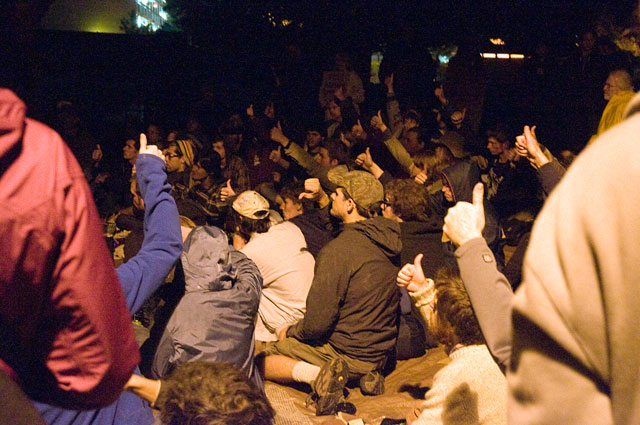
October 8 ~ Occupy Santa Cruz, Glimpses

Last Night at OCCUPY SANTA CRUZ

by Alex Darocy Friday Oct 7th, 2011 2:38 AM
occupy-santa-cruz-17.jpg

General Assembly
by Alex Darocy Friday Oct 7th, 2011 2:38 AM
chris-doyon-occupy-santa-cruz-18.jpg
chris-doyon-occupy-santa-...

Chris Doyon.

Friday, October 7, 2011

October 7 Beach Gift to Occupy Santa Cruz

Occupy Santa Cruz, a Tidal Offering

This morning at Twin Lakes Beach, P-sign Paul gives a big thumbs up to OSC as the sun shines and our momentum builds

This morning at Twin Lakes Beach, P-sign Paul gives a big thumbs up to #OccupySantaCruz as the sun shines and our momentum builds.

This morning at Twin Lakes Beach, P-sign Paul gives a big thumbs up to #OccupySantaCruz as the sun shines and our momentum builds.